Showing posts with label Wednesday Is Any Day For All I Care (Comic Reviews). Show all posts

Thursday, July 17, 2014

The Seventh Circuit Court of T.H.U.N.D.E.R. Appeals For All Anyone Cares #18

T.H.U.N.D.E.R. Agents #7 (1966)
Dynamo #1
T.H.U.N.D.E.R. Agents #7 (2011)
T.H.U.N.D.E.R. Agents #7 (2014)
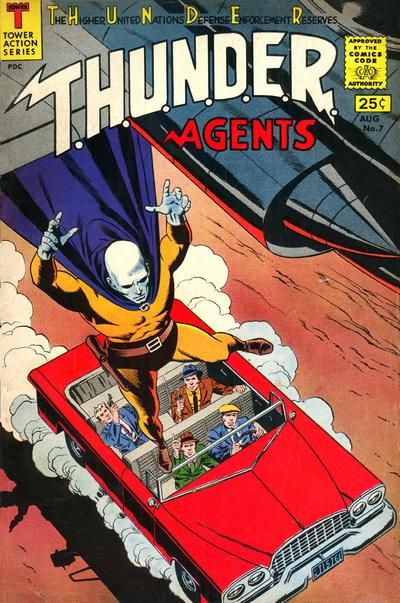


T.H.U.N.D.E.R. Agents #7 (Tower, 1966, 25¢)
Hey look, another classic Tower issue in my possession! However, I didn't read any of these stories prior to picking up the second volume of DC's T.H.U.N.D.E.R. Agents Archives, so no rosy glow of nostalgia here. This issue had a lot to live up to after the exceptional prior edition, and at least at the start, it seemed like it would meet the standard set there.

The opening Woody Dynamo story had a swell hook, our downtrodden hero reflecting on his being wanted for treason. That would have been a good engine to run a longer story, or even to launch the Dynamo solo series that came out the same month. Too bad they kept things short and simple, a cute ten page yarn that wraps up easily. The story is interrupted by an ad for the "Commander Abdominal Supporter Belt," but that girdle isn't fooling anyone.

There's a lot of good to be said about the Lightning strip. The returning Warp Wizard has a power that believably checks a super-speedster, unlike making rain or champion boomerang throwing. Mike Sekowsky depicts the villainy well, with a particularly suffocating countdown to doom. Steve Skeates' dialogue pops, but if I had to finger a problem, it would be with the writing. This is the second time Skeates has used the same villain in two consecutive installments of the strip, and for every inventive turn taken, there's something dumb that has to happen because the script said so. All in all though, Lightning is one of the book's most consistent entertainers.

"Subterranean Showdown" was weird. The art was credited to George Tuska, but he's barely recognizable. There's a bunch of continuity references in the story, but characterization is way off. Dynamo is an over-eager sexist nitwit, Kitten Kane is a useless coward, and NoMan is cavalier with the life of a fellow agent. The return of Dynavac has potential that is squandered, and a whole new one-time power is invented for an agent to wrap things up. A Dynamo pin-up is repurposed into an ad for his spin-off book, and then Iron Maiden gets her own lovely dossier page by Wood and Dan Adkins. Next up are full page ads for Fight The Enemy and Undersea Agent, then a letters column. An editorial reply noted "Lightning has become tremendously popular."

I guess I spoke too soon about John Giunta taking over Menthor, as he was moved to NoMan after only two months, though it's understandable once you get to the last story of the issue. Before that though, Bill Pearson offers a histrionic Invisible Agent under circumstances that are understandable but uncomfortable with regard to characterization. NoMan basically flips out over the human opportunities he's lost in becoming a supposedly tireless agent. The good is that this is an unusual story for its time which sets NoMan apart from other companies cookie cutter crimefighters, but on the other hand, it kind of invents NoDickery. Giunta appears more comfortable with this character than Menthor, though perhaps the inks of Sal Trapani helped.

Finally, the big one, likely the most highly regarded and oft-noted T.H.U.N.D.E.R. Agents story ever: Menthor in "A Matter of Life and Death!" by Dan Adkins with additional layouts/inks by Wally Wood that render the Steve Ditko pencils barely recognizable as such. It's funny that nobody ever mentions the Ditko part, but you can see it in the body language and the more exaggerated Subterraneans. The story does a good job of pointing out the mishandling of the property to date, including the need for added security measures after John Janus had the Menthor helmet stolen, what, three times in seven issues (with one retrieval spanning two issues?) Where he was once a double agent for the Warlord, that promising angle was forgotten after the second issue, so a new confrontation plays out as straightforward as it would with any other Agent. There's no internal conflict in Janus anymore, and while his physical prowess is again highlighted, it's not enough to get the job done. Dynamo is often compromised, but where he always ultimately works out a "no harm, no foul" remedy, Menthor was only ever a guy in an Atom costume with a less novel gimmick than shrinking. With this story, he serves a higher purpose, and though it's slightly clunky, that only helps to offset the infamous turn it takes toward the end. The somber tone isn't what I read the book for, but this story was a trailblazer that kept its promises.

As I'm sitting here comparing my Archive Edition to my lower grade original copy with light brown pages, I've got to say how much I appreciate DC's superior reproduction. Solid blacks replace grays, muddy flat colors are made both more vibrant and more subtle... unlike many other garish modern reprints I could point to, the Archives work entirely in service to improving the presentation quality of these stories over their initial run. Kudos! By the way, you're only missing out on ads for 200 toy soldier "comic flats," learning to play guitar, and hypnosis.
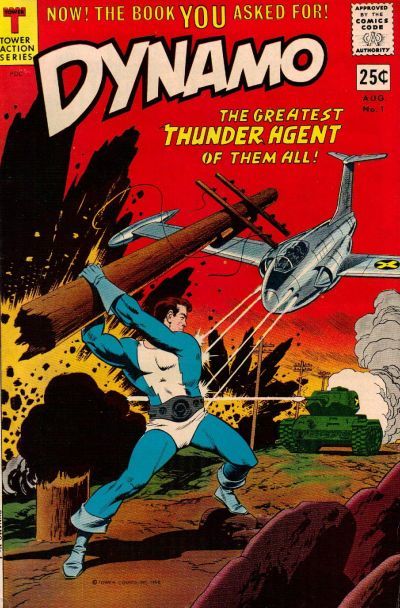


Dynamo #1 (Tower, 1966, 25¢)
Say, yet another issue I own the original of but have never read before, and like T.H.U.N.D.E.R. Agents #7 this one also has an ad for a "Magic-Scope" on the inside cover and an engaging Dynamo splash page by Wally Wood! Running across the lunar surface while being strafed by a flying saucer? Sold! Shame my opinion on the "traitor" story bares out here. A good chunk of the first portion of this yarn was dominated by NoMan, and considering this is the first story in a new ongoing series, none of the characters are properly introduced to a potential new audience. On the other hand, it was fun to see a tale like this from before man had actually walked on the moon, where the technology and concerns about failure of same are contemporary and realistic. At the same time, matters felt drawn out, there's too many arbitrary developments, and the menace remains shrouded in mystery. If it wasn't for the glorious art, this would have been a sorry way to launch a new book.

"A Day in the Life of Dynamo" seemed off to me. I'm used to Mike Sekowsky on Lightning, and he doesn't feel right on Dynamo, plus his work is buried under Frank Giacoia's inks. The story aims for humor but misses, coming off jingoistic and diminishing a host of prior villains in rapid succession. "Back to the Stone Age" was much better, with a more comfortable, funny script and great art by Reed Crandall and Wood. The team-up of Demo and Dr. Sparta didn't amount to much, as it was Sparta's gimmicks, cast, and characterization that carry most of the tale, but so long as it was a good one, right?

Dynamo had a few different ads from the mother book, including one for its seventh issue and Undersea Agent #4. I have one or two issues of the latter, but I wish someone would reprint them. I'd have rathered DC put them in their Archive Editions instead of the cheaply available upscale format Deluxe series, but maybe IDW will include them in their otherwise redundant current series of trade collections. Also, there's ads for a seven foot replica "Polaris Nuclear Sub" that fired torpedoes, and a life-sized, personally autographed pin-up of David McCallum for $1.

Thanks to Steve Ditko doing full pencils, the layouts on "Dynamo meets the Amazing Andor" are clearly his, despite heavy handed inks from Adkins & Wood. This is a highly unusual story for the line, as it begins twenty years previous, prior to the formation of T.H.U.N.D.E.R., and offers an honest to gosh superhuman. Also, we learn here that there's a whole council of Warlords with a "Mighty Overlord," and individually named Subterraneans. Also, as I guy who's read more revivals than original issues, I'm familiar with prominent mentions of Andor, but had never read an actual story with him. He seems to be like the original Amazing Man taken to the nth degree, which makes him a serious badass who's still vital as an adversary at story's end. He also seems like an attempt to revisit the original Menthor premise and hopefully better see it through this time. My guess is that subsequent publishers held Andor in reserve for later storylines that never materialized in the face of swift, unexpected cancellation. I'll be surprised and disappointed if he doesn't turn up again in the Tower run. My only complaint is that Kitten Kane has forsaken all of her feminist credibility since the T.H.U.N.D.E.R. Squad lost their feature, with Alice Robbins being a more capable, reputable damsel in distress.

Finally, a Weed solo strip, returning to the lighthearted mundanity that's been missing from the Tower comics! After being beaten over the head with the Guy/Kitten relationship dramatics of the '80s series, it's jarring but nice to see Gilbert go out on a date with some random Olga chick. Hey buddy, you may be dying one speeding mission at a time, but you're not dead yet! If that doesn't work out though, room can be made for Weed! John Giunta can't draw sports cars, but he's a fair fit for "Mr. William Wylie" (in case there was any doubt that he was Wallace Wood's analogue.) Nice to see the Agents in a fun story, and even Menthor is redeemed somewhat by a villain who would have been a natural in his strip showing up all of his fellows at once.
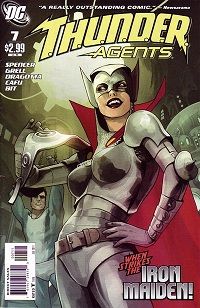


T.H.U.N.D.E.R. Agents #7
(DC, 2011, $2.99)
I don't understand the thought process of modern writers. This book presumably licenses the rights to the lyrics of the Dion song "The Wanderer," which "plays" in full on a radio across several pages of a flashback that gives way to more pages of a domestic scenario. Then there's a sequence of violence, and the whole thing is bookended by a page each of basic context. None of it involves much dialogue. Even if this were the storyboard for a movie, that's maybe two minutes worth of finished film. Gave Mike Grell some work, at least.

I assumed the five page back-up strip was drawn by Paul Smith until the credits revealed it was actually Nick Dragotta, which should be taken as a compliment. The strip revisits a dynamic that dated back to the '60s comics and informed the lead story. It's so much more enjoyable and full than the Grell story that by rights they should have switched page lengths.
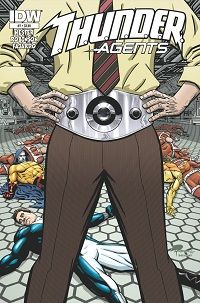


T.H.U.N.D.E.R. Agents #7 (IDW, 2014, $3.99)
I seriously thought that with IDW behind it, this volume of T.H.U.N.D.E.R. Agents might reach and exceed the longevity of the Tower original. Instead, I finally realized they had quietly canceled the book with the eighth issue only after it had gone months without new solicitations. It's not like they had the smartest business plan anyway, reprinting the old comics that DC had already reprinted in readily available Archive Editions, only marginally cheaper and with questionable extras (vintage ads? Whoopee.) DC caught the edgy Nick Spencer just as he was getting noticed, while Phil Hester is a veteran without any heat doing a fairly traditional super-hero book. Coupled with the licensing fees for Radiant Assets, LLC, whoever the hell they are, it's no wonder the ongoing turned mini-series double quick.

Last issue ended on a cliffhanger that cut to the core of the team's lore, and I wonder how far in advance Hester knew he needed something big enough to draw the volume down. After reading the Dr. Sparta story in Dynamo, I wonder if the kid here was originally supposed to be Wilbur and his elder Sparta. While the script was well done, in retrospect it's odd that Hester referenced an Undersea Agent and introduced an all new Lightning (did he ever get named?) plus revisited John Janus and Dr. Sparta in these last issues only to return the story to the ancient towers that dominated the first four issue arc. This issue was exceptionally busy with turnabouts and cross-cutting. I continue to enjoy Roger Robinson's art, especially his use of tones little seen since computer coloring took over shading. I have some issues with changes Hester made, but seeing the potential of the book and some smart decisions that were made, I'm sorry to see it go so soon.

I'll have to stop complaining about the Subscription variant covers, because at least they offer a choice. If I recall correctly, the gorgeous Jerry Ordway variant I got was used in the solicitations, whereas I don't believe the standard Roger Robinson was, and that's a whole lot more businessman crotch than I'm game for.


Saturday, May 31, 2014

Six Degrees of T.H.U.N.D.E.R. For All Anyone Cares #186

T.H.U.N.D.E.R. Agents #6 (1966)
JCP Features The T.H.U.N.D.E.R. Agents #1
T.H.U.N.D.E.R. Agents #6 (2011)
T.H.U.N.D.E.R. Agents #6 (2014)


T.H.U.N.D.E.R. Agents #6 (Tower, 1966, 25¢)
In the interest of full disclosure, I have to point out that this issue was probably the first of the original Silver Age series I ever owned, purchased at SDCC in 2000 during my only wonderful trip there. There's a lot of positive association for me, but at the same time, I feel I can objectively say that it's a great issue. I don't know that I ever made the connection between the Red Dragon's appearance as I read it (a reprint story in #20 from issue #3) versus "Dynamo and the Sinister Agents of the Red Star," but this titular disciple put the original villain to shame. Red Star has a better costume, contrasting against Dynamo's blues, and his martial arts finesse allows him to work over the powerhouse using his own misguided muscles. For me, this is a quintessential Dynamo yarn, with troubled romance, job problems, very cheeky humor, charming Cold War super-spy tropes, and heroic difficulties that embarrass and stymie without making Len Brown look like a meathead. The women are strong, sexy and respectable, the villains cunning, and the art by Wally Wood and Dan Adkins stunning. I also have to point out the silent semi-splash where Dynamo is fired like a torpedo toward the enemy submarine. It's only two-thirds of the page, but by using the surrounding panels for set-up and the simple restraint of not using the same trick anywhere else in the story, it has vastly more impact than one of Ivan Reis' lovely but limp mini-portfolios DC has the nerve to call comic book these days.

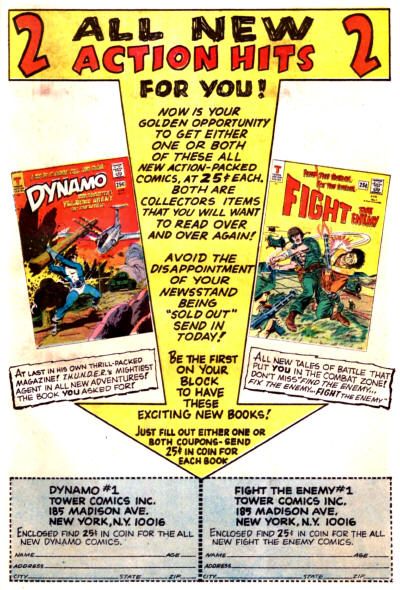
Since I have the actual Tower comic for once, I'll point out the presence of a house ad here for Dynamo #1, which you could get free with a ten issue subscription commitment to T.H.U.N.D.E.R. Agents for just $2.50. It was strategically placed after the Dynamo story, opposite an ad for Balentine Books' Edgar Rice Burroughs collection. Later in the issue, they plug Dynamo #1 again as a twenty-five cent single issue direct mail offer to "Avoid the disappointment of your newsstand being 'sold out,'" along with Find the Enemy... Fix the Enemy... Fight the Enemy #1.

Given what a blatant rip-off of the Flash he is, and how I've never liked speedster characters, I have to admit that the Lightning strip was one of the most consistent in quality of the early going. Steve Skeates, Mike Sekowsky & Frank Giacoia clearly had a solid Flash run in them, and they were all moonlighting from DC Comics anyway, but absent that opportunity they deliver the goods here. Guy Gilbert is frankly not as bright as Barry Allen by half, but his military background offers a different path toward problem solving that entertains. Sekowsky brings his wily, rocky vibe to the premise, making up for the lack of Flash Facts with shaggy dog charm and a greater propensity for violent overtures. "The Origin of the Warp Wizard" could have easily been a dog, especially with the villain looking like Doc Brown on crack in a bland all purple get-up, but he sells himself with his wry grin and mad twinkle of the eye. It's still odd though how for a dude being slowly killed by his powers, Guy never once takes the Lightning costume off and seems completely disconnected from the T.H.U.N.D.E.R. Squad. I miss them.

"T.H.U.N.D.E.R. vs. Demo" once again answers questions I'm not sure anyone was asking, but Woody seemed bound to ride herd over the shoddy continuity between the strips in the team feature through the power of the retcon. Demo's appearance in the previous issue didn't seem like it was going to amount to much more than a Gil Kane showcase, but here it becomes the spine of a key event. Having gotten a taste for NoMan's invisibility, Demo sets out to steal all of Professor Jennings' creations from the individual super-agents, which sets off a string of events that returns his girl Friday Satana in a new role and would lead somewhat to a major character death in the next issue. Where I complained about the inks of Wally Wood & Dan Adkins overwhelming others, John Giunta's dated, cluttered style benefited much from their strong influence. Demo starts a line trope here, but there's cute wrinkles in this story that later derivative works could have used.

Speaking of John Giunta, Menthor became "his" character after Sekowsky moved permanently to the Lightning strip, and it did nothing to correct the character's disastrous drift off course. Menthor was the anti-Dynamo, Len Brown being a Peter Parker-like relatable schlub who was capable of overwhelming good, but only ever reaped the whirlwind of unlucky turns and harsh criticism for his efforts. John Janus was supposedly a virtual Adonis who pleased his superiors endlessly, but his stories always seemed to pivot on his being an arrogant douchebag who loses his telepathic helmet to one dubious dope after another. In "The Carnival of Death," the mentalist Zizaqz might as well have been the Entrancer in disguise, and he wasn't even targeting Menthor for a plot-- the idiot just created a situation Zizaqz could exploit. As usual, Janus spends most of the tale trying to shake a mental whammy, recapture his belongings, and bring the bad guys in. When that sort of thing happens to Dynamo, he struggles against long odds. With Menthor, he again keeps a portion of his powers even without the helmet, and still fails at most of his mission goals. The cluttered, coarse art as inked by Carl Hubbell looks a bit like Frank Robbins, but without the idiosyncrasies that make him interesting. There are actually a few amusing turns in this script, but the character and art mute any pleasure they might have brought.

Thanks to my reading multiple chronologies of T.H.U.N.D.E.R. Agents at the same time, I almost missed Steve Ditko's debut work on the series with NoMan in "To Fight Alone." It occurs to me that he would have probably been able to salvage Menthor, who in practice was the most Randian hero of the group, but in principle was supposed to be an evil agent driven to good by technological compulsion. Can't imagine that sitting well with Ditko. Anyhow, despite a script credited to Steve Skeates, it seems unlikely that Ditko didn't have something to do with an anarchist cult leader hypnotizing upright citizens into giving up their hard earned material possessions. Even if that was already in the script, Ditko's presentation makes it all his own. Ditko seems uncomfortable with NoMan's hooded cape, and I'm not sure the glowing eyes he gains here quite work, but the mood and storytelling on display suit the Invisible Agent. There are some fantastically dramatic angles and novel techniques employed that wow, and I appreciate Tower's willingness to let the art tell the story in many silent action sequences. A strong closer for the issue!

JCP Features #1 (John C. Productions Inc., 1981, $2.00)
In rereading the Deluxe and the Archie/Red Circle comics, I realized I'd judged John C. Carbonaro's genuine contributions too harshly against the razzle-dazzle of Singer's. On revisiting this magazine, I wonder how much it contributed to that critique, since it is friggin' terrrr-ib-ble. Total amateur hour torture session. I published reviews of the fifth issues of T.H.U.N.D.E.R. Agents at the end of March, and had read ahead to review some seventh issues by mid-April. This round of reviews were written then, except for this magazine's, and trying to sporadically read it held up posting for two months! I haven't read every T.H.U.N.D.E.R. comic yet, but this is the worst that I have read, and I feel confident that when I'm done it will continue to hold its all time standing at the very bottom.

Why is it so bad? For starters, it's just cheap and shabby. There's a nice painted cover, but it's marred by the crumby hand lettering in the the large ugly yellow boxes pasted all over the piece. The inside cover editorial is typeset, and I mean it looks like someone xeroxed the template, fed the paper into a typewriter, and wrote out the editorial and indicia in one rip. There's poor hand lettering through the black & white story, with ill-advised freehand recreations of old Tower logos. The first "story" spotlights Raven, and is written by Warren editor Chris Adames. It is pure, dry exposition recapping the Tower run in a few pages, mixing hand and typed lettering. Lou Manna would go on to do decent work on the Archie issues, but here he offers a collection of ugly swipes from the old comics. He's inked by Mark Texeira at the coarse dawn of his career, though his embellishment is a highlight compared to co-finisher Pat Gabriele, a never-was with a handful of low rent credits. This is followed by a second "story," which is actually a continuation of the first, and sees a shifting of job duties to Tex pencils, Gabriele inks/edits, and a script by occasional Warren writer Kevin Duane. Ostensibly about Dynamo, it's really just a five page bridging sequence to set up the action for NoMan (mostly by the same team in the same roles.) Where the Tower stories would have been separate single stories, these are unsatisfying, disjointed chapters in one long, damp narrative.

The fourth "story" jumps the tracks so abruptly that you'd be forgiven for assuming this was a legitimate new tale. Not so fast, because creative auteur Pat Gabriele has simply dumped a Kirby pastiche space opera into the midst of the current yarn without set-up or regard for the Tower aesthetic. It looks like one of Jack's Bronze Age bombs, complete with Asgardians/New Gods, but at a fraction of the aptitude. Four pages in, Gabriele cedes the script to the unknown Richard Lynn and inks to Texeira for no apparent reason. The division of labor isn't terribly important, since the whole book is a hash of hoary corporate comics cliché, purple prose, and clunky hand-me-down art diluted by too many chefs. There's no vision and little style, plus it's humorless and charmless in direct opposition to what made the Agents stand out. It's so flavorless that I find myself tuning out as I try to read, like it was a textbook on a dull subject.

I lost track of where we were. Installment six? Lightning? Yeah, or course Guy Gilbert whines about his impending death due to his usage of super-speed. It isn't the scripter's fault that this same scene would play out in nearly every Agents comic until the character was finally dropped in the late '00s, but the only thing added to the lot was Lightning's being able to run from Earth to outer space thanks to "newly designed antigravity gloves." Even in comic books, the suspension of disbelief has its limits.

For thirty-some pages that feel like twice if not thrice that, the Agents exposit or numbly battle inconsistently drawn aliens (reptiles? subterraneans?) and robots while mouthing off crap to fill up space. Then the tiniest of big bads turns up on the last few pages, there's an explosion, and the story ends with... another dialogue balloon of exposition and a crap line from Dynamo to fill space. Oh, and a third of the final page is devoted to a horrible sketch by Kelly Freas of Pat Gabriele offering a brick of typeset words of acknowledgment. Following were a two page reprint excerpt of a Fly story by Simon & Kirby and a ten page Black Hood reprint by Morrow, Adams & Giordano. Just to remind you how professionals do things.


T.H.U.N.D.E.R. Agents #6
(DC, 2011, $2.99)
Worst issue of the series to date. Wally Wood didn't seem to have a problem with illustrating extended sequences of people in offices wearing business attire discussing stuff, but that always gave way to something exciting, usually involving cool looking things having knuckles smashed against their mouths. By comparison, Nick Spencer is a pleasure denier. All of the key action in this issue takes place off-panel, and much of the issue is devoted to characters explicitly not even discussing what happened. Seriously-- characters bring stuff up, and then other characters just say "tut-tut-- mum's the word," and then there's some nudging and winking. Like, six instances of that, and then an Arkham City sneak preview starts. Cafu & Bit illustrated the entire issue this month, so I didn't catch what I guess was an anti-climax to the main story, followed by an Iron Maiden five-pager that also ends so abruptly I was all "whaaat" when Batman and the Joker showed up-- rifling the pages looking for an actual conclusion to the issue in hand. Nothing happens in this issue but characters staring at their navels over stuff the audience only sort of get having happened, and then Iron Maiden rips off the Wonder Woman in Vietnam segment of The New Frontier.


T.H.U.N.D.E.R. Agents #6 (IDW, 2014, $3.99)
Phil Hester has fun reimagining and critiquing a Silver Age villain, which translates to the page. I'm still enjoying the art of Roger Robinson, which I can take more seriously than the book's previous toycentric look. I'm digging most of the redesigned Agents, though I'm still struggling with Robo-Dynamite. A new "old" Agent gets introduced that checks two boxes on the Equal Employment Opportunity questionnaire, and while a bit self-righteous, she's still an improvement over other recent attempts. Can't get behind Weed's altered look though, and in fact he reminds me more of Perez's Raven than a character Woody modeled after himself. Body type is another path for diversity, and all these agents are too uniformly buff. There's a modest undercurrent of political commentary, and subplots brewing, that make this volume seem like it's catching up in quality to the DC incarnation without the vaporous decompression that hurt that run.

Returning to the theme begun last review of Andrew Currie sucking on the Subscription variant cover, this no background having, altogether incomplete group shot added insult to injury by not even being colored. I ordered this sight unseen, which will not happen again. Friggin' IDW is on my list, man!


Thursday, March 27, 2014

A Fifth of T.H.U.N.D.E.R. For All Anyone Cares #184

T.H.U.N.D.E.R. Agents #5 (1966)
T.H.U.N.D.E.R. Action #2-4 (1986)
Wally Wood's T.H.U.N.D.E.R. Agents #5 (1986)
T.H.U.N.D.E.R. Agents #5 (2011)
T.H.U.N.D.E.R. Agents #5 (2014)


So here we are at the fifth issue and, well, the novelty is wearing off. As I've mentioned in the past, I got into the Agents through the short-lived Deluxe Comics series, and only read the Tower books as highlight reprints or sporadic bargain low-grade back issue finds. Reading five different incarnations a month in their individual chronological order in a manner closer to how they were released has given me insight into why the T.H.U.N.D.E.R. Agents have consistently failed in the marketplace.

T.H.U.N.D.E.R. Agents #5 (Tower, 1966, 25¢)
"Dynamo and the Golem" starts off this issue with unsure footing. Reed Crandall was a great artist even before he was thoroughly processed into the house style by inkers Wally Wood and Dan Adkins, but a consequence is that his story looks more like slightly off-model Woody than its own thing. The script has a similar issue, with masked terrorists, Subterranean Warlords and a behemoth for Dynamo to fight. All the expected elements are there, but they don't play out correctly. Len Brown doesn't struggle with the mundane trials of his job before finding relief in physical conflict. Instead of sarcastic asides, Dynamo has a completely silent punch-out for seven panels sandwiched between flat expository dialogue (followed by more cycles of the same.) Dynamo is perhaps too competent, recalling Menthor as that character shows up and falters in a cameo, swapping hats. The story even ends back at HQ with Alice Robbins, but with propagandistic sloganeering replacing romantic misunderstanding/petty bickering. Aside from the lovely visuals-- hell because of them-- the tale brings to the fore the Dynamo formula of coming up with goons for the hero to toss around and something big for Len to punch without much regard for logic or nuance, simply coasting on visuals. For a character only a couple of months away from having to support his own giant-sized solo spin-off title, this tale underlines how little creators have to work with there in the absence of the Woody sheen.

NoMan "In the Caverns of Demo" has a few more surprises, not all of them good. The famed Gil Kane returns for the first time since the debut issue on a different strip, and while it's still a looser, lesser job, Kane suits NoMan better. Demo also returns to become NoMan's first recurring foe, and his presence is set up through a retcon that backs up Iron Maiden's situation in the previous issue. You get a strong impression of how momentous T.H.U.N.D.E.R.'s defeat of the Warlord was in the second issue while simultaneously making clear that G.I. Joe already beat their Cobra and have no one substantial to fill that void. Further, there's no reason Demo specifically needs to be in this story beyond it dispensing with set-up and affording fan service continuity clean-up. The island of "barbaric sub-breed" humans could only have been worse if they were not unambiguously Caucasian (this time.) It's an okay adventure with solid art, but rote in a title becoming defined by being rote.

Dan Adkins provides a peachy pin-up/dossier entry for Lightning, which seems like a precursor to Who's Who/OHOTMU. It contrasts sharply against the Lightning story that follows by Steve Skeates, Mike Sekowsky & Frank Giacoia. In their forward to T.H.U.N.D.E.R. Agents Archives Volume Two, Robert Klein and Michael Uslan noted that the Lightning strip was the closest to standard super-hero fare and was created under the greatest autonomy away from Wally Wood's editorial eye. Put more critically, it was bog standard for middle rung DC of the early Silver Age, not inventive enough for Julie Schwartz, but maybe a decent effort out of George Kashdan's office. No one should be impressed that Baron Von Kampf is already back. Oh hey, I just got that. Since he's Lightning's first recurring foe, would Guy refer to him as "Mein Kampf?" Speaking of Guy Gilbert, his being in the suit seems of no consequence to the story; sub-Flash fare without reference to the T.H.U.N.D.E.R. Squad or even what Guy looks like under that mask. Mediocrity runs so deep that the Lightning logo can't escape falling below standard. Sekowsky's idiosyncrasies are the only saving grace here.

"Menthor vs. the Entrancer" proves the general rule that the worst written story of any given issue will probably star Menthor. John Giunta isn't stingy with panels per page, especially during the villain's origin sequence, but his style is a tad dated and the story being told feels like a throwback to the late Golden Age. The Entrancer is a thuggish lift of Doctor Strange, which by T.H.U.N.D.E.R. bad guy standards is rather advanced developmentally, but he comes to a limp end in a dull yarn. The basic premise of John Janus being an evil double agent stymied by his helmet seems to have been forgotten, and his supposed role as most qualified T.H.U.N.D.E.R. Agent is undermined by mistakes and dependency here. It doesn't help that there's no consistency in his creative pool from month to month. Remember how Janus now has powers even without the helmet? Neither does the scripter. Between his highly derivative costume and the lack of investment in the character behind the scenes, it's no wonder that telltale zero on his brow is starting to look more like a target bullseye.

"Double for Dynamo" closes out the book with a team feature, and makes clear that kids were paying twice the standard comic book cover price of the time for this story and a bunch of ballast. Steve Skeates continues along the thread started in his NoMan story of last month with a frantic search of T.H.U.N.D.E.R. for android replacements. It's too bad for the promising premise that they have a reliable detection method in place from page one, and that no one of consequence was found to have embedded themselves in the agency. The Mastermind is a bit of a goofus nogoodnik who literally does a bellyflop before this whole affair resolves. He's outclassed by his masked minions, who looked to have inspired the Black Spider from '70s Batman comics. The tale is light entertainment drawn by the Wally Wood studio, and the main takeaway is that the T.H.U.N.D.E.R. Squad's Weed was being actively groomed as a street smart sidekick for Dynamo.

T.H.U.N.D.E.R. Action #2-4 (Savoy, 1986, 75p)
Once again, I've never had copies of these books in my hand, relying solely on the internet for my reading pleasure, as can you. Aside from badly (and likely illegally) reconstituted British Tower reprints, the final issues of T.H.U.N.D.E.R. Action also offered two full color (colour?) newly (amateurishly) created tales by artists Eddie DeVille and Jon Sussex. The NoMan feature is brief with a predictable non-twist (and an unforeseeable panel of gratuitous nudity. Blame Page 3.) The Dynamo & Iron Maiden story echoes Menthor's closing comment from the fifth issue of the Tower run, "You may not be smart, Len... but you're sure lucky!" Both stories are actually fairly inventive for three page filler. Why everything has to take place on private islands off the coast of New England, I don't understand.


Wally Wood's T.H.U.N.D.E.R. Agents #5 (Deluxe, 1986, $2.00)
I have yet to replace the copy of The T.H.U.N.D.E.R. Agents Companion I ordered a few months ago, only for it to "mysteriously disappear" at my old shipping address, but I do have other Twomorrows magazines lying around that covered some of Deluxe Comics' scams. I used to defend David Singer based on his own line of bull and superior product versus Carbonaro, but on further inquiry, he seems to have been super shady. His last editorial page in the final published issue of Wally Wood's invokes Nixon by name, which would be damning enough. Following this with a Jerry Ordway illustrated story that throws several Agents under the bus to promote awful seeming Codename:Danger characters in a never-to-be-finished crossover is itself a criminal offense. Ordway is the most obvious and potent direct inheritor of Wood's artistic DNA, and for fifteen pages we visually received the finest revival the Agents deserved. However, the story is lame, waving away what should have been a continuation of a previous subplot with a line of dialogue, and setting up new threads to dangle forever. It's a shame, especially since Roger McKenzie's script pops when he's not tripping over Singer's junk, and even Paty's coloring steps up.

There's an all-text advertisement for 1987 Honeymooners and Buckwheat calenders offering "trivia, dates of importance" and such for just $9.95 shipping inclusive ($20.56 in 2014 dollars.) Even accounting for Eddie Murphy's years old series of Buckwheat SNL skits, even if somebody would have wanted these things in 1986, could there have been a worse way to advertise to them than an all-text page?

The Lightning strip goes out as it came in-- an abomination. The serial killer "mystery" is solved through the revelation of a previously unseen figure from Guy Gilbert's past that thinks in heavy exposition with a bad "accent." In case you were concerned that the misogyny might lighten up, no worries, a lovely professional is hideously disfigured and her eyeballs gouged out (partially) off-panel. Keith Giffen continues to cut as many corners as possible to lighten his workload with barely comprehensible narration full of extreme close-ups, shadows, stats, and general abstraction. The Bierbaums' script continues to anticipate the demeanor of message board trolls. Nothing is or will ever be resolved to anyone's satisfaction, but at least I don't have to read this anymore.

Singer is joined by Mike Harris for a cheeky, copyright flouting Dynamo lark that tries to near literally treat the character as a Superman clone in the fashion of Christopher Reeve. The Big Two pseudo-cameos at a costume party aren't appealing, but it is fun to see period obscurities like Grimjack, Sable, Aztek Ace, Thunderbunny and so on. Still hard to see the point, as it isn't exactly funny, nor is it a character study, and it certainly isn't exciting.

The capstone on the run is yet another Dynamo tale that doesn't do the property any favors. The creative team behind the minor black & white boom hit Ex-Mutants; the now forgotten Anthony Pereira, John Statema and Mike Witherby with '90s Marvel poster boy Ron Lim; offer an inane yarn seemingly designed to fill as much space with as little of consequence as quickly as possible. Ignominious indeed. Say, did you know Rob Liefeld, Jim Balent and Dale Keown used to do covers on that series in their early days, and it launched Paul Pelletier's career? Marvel owns that now, right? I don't remember it being all that great, but you'd figure if it was still on the market, somebody would have done an omnibus by now.


T.H.U.N.D.E.R. Agents #5 (DC, 2011, $3.99)
This series is frustrating. It's telling one of the most sophisticated and involving stories of the lot, but doing so in the least satisfying manner episodically. For instance, this issue has a five page flashback sequence well rendered by Ryan Sook that serves up needed exposition. The rest of the book is another strong showing by Cafu & Bit where pieces set up in previous issues finally begin to click together. Then, it just stops, again. Every month, about the point where Nick Spencer has ratcheted up your interest, he breaks off to have a smoke and stargaze. He's screwin' just like a Chinaman.


T.H.U.N.D.E.R. Agents #5 (IDW, 2014, $3.99)
I think this was my favorite issue of this run so far. I previously had trouble getting past Andrea Di Vito's high-end licensed toy comic visuals, where new artist Roger Robinson is more of a storyteller. Robinson isn't as polished, but he brings mood and more varied angles. Colorist Rom Fajardo is still swell, but he seems to be taking greater license with his contributions, adding digital squiggles and other bits of personal panache. With the main characters established, there's a greater sense of their moving toward an overarching story, rather than being pieces of P.O.V. in a perfunctory scenario. I also like the nods to Tower, playing on reader familiarity to create foreshadowing, but in the present enough not to lose new readers. I do have one complaint. I've been buying the Subscription variants, which tended to have bigger name artists and play with the classic incarnation more often. With #4, I bought two copies, so I could make use of the blank sketch cover this convention season. Starting with #5, Andrew Currie has taken over the Sub covers, and it's plainly inferior to Robinson's standard cover. It's so bad that I might have to rethink my buying habit.

Thursday, February 27, 2014

Born on the Fourth of T.H.U.N.D.E.R. For All Anyone Cares #183

T.H.U.N.D.E.R. Agents #4 (1966)
T.H.U.N.D.E.R. Action #1 (1986)
Wally Wood's T.H.U.N.D.E.R. Agents #4 (1986)
T.H.U.N.D.E.R. Agents #4 (2011)
T.H.U.N.D.E.R. Agents #4 (2013)


T.H.U.N.D.E.R. Agents #4 (Tower, 1966, 25¢)
"Master of Evolution" was a paper thin excuse to have Dynamo punching dinosaurs, which wouldn't normally be my thing, but Wally Wood makes it work. The writer Len Brown gets into Schwartz style couple dysfunction through Alice Robbins, which also could have been off-putting, but she's a woman drawn by Wally Wood. That's never not okay. The story needed to be a bit bloodier, and I mean that objectively in context, plus I mentioned its gratuitous nature already, but ultimately a competent Dynamo yarn with perks.

"The Synthetic Stand-Ins" sees Mike Sekowsky trade off of Menthor to a NoMan strip, and he's not really an apt choice on this character. Steve Skeates' script pops though, which helps make up the difference. Cool spy action that makes use of NoMan's unique abilities, plus some neat looking goons and a "The End...?" Could launch a lot of stories off that ominous note.

Wally Wood offers a pair of single page infotainment pieces, "NoMan in Action" and "The Origin of T.H.U.N.D.E.R." I miss well executed introductory material like this, but Woody also plants an easter egg for the old timers in the form of a nonchalant peek at a new Agent. Having set that pin, the following T.H.U.N.D.E.R. Squad story (by the same team as "Stand-Ins") knocks it down. Jeez, only T.H.U.N.D.E.R. would invent a super-speed ray to combat a gas instead of just offering its operatives masks, or correctly outfit its bases. Sekowsky is much better suited for the Squad, but Skeates throws them under the bus in a rather bruising way here. I did like the line's-width-distance-from Nazis. Too bad they didn't bother to name the first scientist after Professor Jennings to create gear for an Agent.

Was "The Return of the Iron Maiden" really necessary, since she only missed one issue? They even go to the trouble of breaking her out of prison, despite her not having been shown getting arrested in her previous story. We could have skipped right into the latest adventure, y'know? Especially when you factor in that she had yet to be unmasked, so she was captive in full armor. For reals? Moving on, Dynamo proceeds to lose any ground gained in credibility from the first story here. I do get a kick out of Agents making cameos in each other's strips. Maiden has some moments, and Dynamo gets the last, um, frown? I'm uncomfortable with the villain, Doctor Death, because he's either a Subterranean in disguise or a gross Arab caricature. I expect better from Woody.

Menthor closes out the book on the same artistically off note as NoMan started, drawn this time by John Giunta and company. Sekowsky helped distance Menthor from his Gil Kane origins, but here he swings back to looking exactly like an Atom knock-off, not that it would be a problem for too much longer. I assume the cliffhanger ending to the T.H.U.N.D.E.R. Agents story from last issue inspired the change-up, but feeding a team story back into a solo strip sounds like a whimper. It's a weird yarn, involving an early example of the power internalization trend and a late example of employing a friggin' stage mentalist. There's too much bad plotting by convenience without forethought, and why doesn't anybody strip John Janus out of his dang costume? Bad enough to stay on the bad side of so bad it's just bad.

T.H.U.N.D.E.R. Action #1 (Savoy, 1986, 75p)
Back when the T.H.U.N.D.E.R. Agents were popularly thought to be in the public domain, a British company briefly put out a magazine of unauthorized Tower reprints. This issue offered "First Encounter," "The Iron Fog," "Iron Maiden," and NoMan's origin tale, all from the 1965 T.H.U.N.D.E.R. Agents #1. There were also two newly created black & white strips. One starred Jonathan Shatter and his partner Roxanne as agents of the European Aerospace Intelligence Agency in near future tales taking place in the United States of Europe. I don't own actually copies of this book, or even replications in its entirety, so I can't expound on that.

The other new material was "Cloud of Death," a small feature credited to artists Eddie DeVille and Jon Sussex. In it, a Soviet soldier gets vaporized, turned into a sentient storm cloud, and drifts to Kansas to launch an attack on an Air Force base. Dynamo, with the exacting direction of some bossy guy at T.H.U.N.D.E.R. H.Q., manages to turn the Soviet Stratus into a rainstorm through liquid oxygen. It better recalls Charlton with its typed lettering and propagandistic plotting, but there are worse ways to spend three pages.


Wally Wood's T.H.U.N.D.E.R. Agents #4 (Deluxe, 1986, $2.00)
The inside cover editorial gets a bit hinky, with David M. Singer dismissing the legal challenges launched against this series and taking pot shots at The Comics Journal. Rather strident, given that there's only one more issue before the whole enterprise crumbles.

George Pérez returns to Raven, and that's the most good I can say about it. Dann Thomas spent her writing career credited on the back end of "Roy and" for a reason. The villains of this story are extremely lame, and their scheme impossibly dumb. Raven has to be stripped to his man-panties and disarmed to be presented with the slightest challenge, and quite frankly, manages to under-perform in the face of such shoddy competition. As saving graces go, Pérez is a fantastic asset, but he's not complimented well by Wally Wood's old studio mate Dan Adkins. I kind of wish Adkins had just gone off and done his own story, instead.

It continues to be a labor to plow through the thick bricks of unedited text that make up the oddly placed L.E.T.T.E.R.S., but it's only two pages this time. Apparently, there's an unpublished John Workman Kitten solo story out there, and the Pérez Raven stories would have been collected into a trade paperback with new material if Deluxe had survived. A four issue Iron Maiden mini-series was in the works, as was the Tales of Thunder companion book. It's neat to get a peek at what could have been if Singer had maybe licensed the property from John Carbonaro instead of trying to steal it.

Keith Giffen and the Bierbaums continue to make the Lightning solo strip a hideous slog. This issue, an ill-tempered, coldblooded superior officer tries to dictate nasty terms to Guy, with ambiguous results. It's an ugly, opaque, mean-spirited story involving child murder, and I could have done without it. Giffen did a better Lightning splash this time, at least.

There are ads for Dave Cockrum's short-lived Futurians and Giffen's shorter-lived March Hare. I can't recall if I ever read any issues of the Cockrum book, but he was missed in this title. The ad was weak, riffing on a far better series of Marvel spots for Power Man & Iron Fist, and Cockrum didn't bother with backgrounds or even the lower halves of his figures. I still have a copy of March Hare, read once in the late '80s and never again.

The concluding half of the NoMan story was extra cheesy. Cy Klopps only got more ridiculous, and NoMan's big gambit doesn't make much sense. Regardless, it's Steve Ditko rendering the goofy with gonzo gusto, making it worthwhile in spite of Steve Perry's clumsy script (did the chief actually call someone "dude?") and a coloring error by inker Greg Theakston that hampers the effectiveness of a punchline.

I first read these issues about twenty years ago, and I'm sure my enthusiasm over being introduced to the rich history of the Agents at a time when so many undercooked "universes" by inferior hands were vying for my dollars helped me overlook some now obvious shortcomings, exemplified in the group story. To review, Steve Englehart wrote the first entry, going so far as to copyright his script, but David Singer wrote the dialogue over his plot for the second chapter. Dave Cockrum drew the first three stories, and wrote the first half of a second two-parter with plotter Singer. The second half of that story was plotted by editor Brian Marshall, scripted by Singer, and drawn by Rich Buckler. Nobody seems committed to this project but Singer, who liked to crow about getting top of the line talent. That may have been true of the pencil artists (including Pérez, who infamously struggled to tell anyone "no,") but he got those names by paying something like double their normal rates. Then he would dig up old journeyman inkers to muddy up the expensive pencils, followed by simplistic, garish coloring with poor separations printed on paper stock that made those bungles glaring. He had a great letter in John Workman providing some of the worst work of his career, with hand-written "typos" and flimsy "fixes," probably done on the sly. The most egregious deficiency was in the writing department, mostly handled by lesser lights, then-unknowns and never-wases. This issue's tale rushes to resolve as many plot points as possible in serviceable fashion, absent Cockrum's charm. The primary story is the ickiest fan service nonsense. The only interesting element is a conniving bureaucrat so completely lifted from Shooter's Avengers that he's even a ginger like Henry Peter Gyrich.


T.H.U.N.D.E.R. Agents #4 (DC, 2011, $3.99)
George Pérez is exactly the caliber of artist you want for this type of project, especially given his history with the Deluxe volume. Getting proper inks and not doing the work while moonlighting from Crisis on Infinite Earths also means his work here is better than what he could offer in 1985. I appreciate that DC allowed the property to exist in real time, and to incorporate elements of many different incarnations (including some that were yet to be seen at this point.) As much as I enjoyed the five page history lesson, it's hard not to resent it taking until the fourth issue to be delivered instead of launching the series. I did like how well Cafu & Bit's art contrasted against Pérez, clearly delineating the return to contemporary narrative. I'm not as into Nick Spencer's talky-talky dialogue and irritating characters, but I'll give him credit for setting up a solid last page twist.


T.H.U.N.D.E.R. Agents #4 (IDW, 2013, $3.99)
With this issue, the main initial conflict is resolved. After decades of Guy Gilbert being a whiny little bitch about the Sword of Damocles hanging over his head, it's nice to see him as the non-costumed, assured Squad member of the early days at Tower. I don't think they've revealed who Lightning is in this volume, but his costume isn't too bad, and I'm curious to see what assuredly ill fortune awaits him. I'm okay with working the subterraneans in early, but they don't make much of an impression, especially with their primitive capabilities in comparison to the '60s version. I'm not at all into the new situation created for Dynamite, but nuDynamo got some needed backstory. Despite constantly reminding me of Ron Lim and early Paul Pelletier, the art of Andrea Di Vito grew on me, so it remains to be seen how I receive the replacement artist. I don't know if I ever mentioned it, but I also liked Rom Fajardo's colors. I still have to file the book under "fans only" though, unless you're flush enough to pay $4 for a safe, comfortable, '70s-80s style team book.

Monday, January 13, 2014

Wednesday is a Third of T.H.U.N.D.E.R. For All Anyone Cares #182

T.H.U.N.D.E.R. Agents #3 (1966)
Blue Ribbon Comics #12 (1984)
Wally Wood's T.H.U.N.D.E.R. Agents #3 (1985)
T.H.U.N.D.E.R. Agents #3 (2011)
T.H.U.N.D.E.R. Agents #3 (2013)


T.H.U.N.D.E.R. Agents #3 (Tower, 1966, 25¢)
"Dynamo battles the Subterraneans" opens with a boss splash and a page that uses Len's boss to explain why working folk should hold Brown dear to their hearts. Dynamo is no James Bond-- just a capable regular guy put through the wringer by his employers for suffering the exact same whims of fate as most super-heroes. I also adore the "of its time" aspects, like references to '50s sci-fi/military programs or something as simple as Len's blazer. The story is too brief for the stakes, but it leaves you wanting more. Dan Adkins' pencils look enough like Wally Wood after embellishment that I couldn't tell any difference.

The handicapped villain in the NoMan segment would be more novel if you weren't distracted by the off-color joke possibilities of Vibraman. Maybe that's why it was reprinted in the last issue of the Tower series, which I picked up years before the DC Archive Edition was available to me. There's some nice bits, including a new wrinkle to NoMan's abilities. John Giunta's pencils are clearly more staid, but Woody and Coleman ink him back to model.

"Dynamo and the Menace of the Red Dragon" had the same creative team as the first tale and was also reprinted in T.H.U.N.D.E.R. Agents #20. It was in fact the last story Tower printed in the series, so it has a ringing finality in my mind that isn't reflected by its true chronology. Until I reach the true end of the series through these reviews, I guess "my" Agents ends with Len going out on a date. My sad little anecdote aside, I can't decide if it was topical or in poor taste that Dynamo goes to "Vietnesia" to save the superstitious soldiers from manipulation by the Commies. I wish the Red Dragon had been built up more, because I liked seeing an Agent battle a costumed foe on an even keel without somebody looking ridiculous. One thing this series was great at was multi-panel sequences that build up a moment, so that you don't forget the sense of wonder that comes with the Agents' powers.

Throughout the issue, there are pin-ups of the individual Agents that list basic details like physical features and abilities, a forerunner to Who's Who and OHOTMU. Each is sweet, though it's curious that Professor Dunn had a bust in his as a reminder of what he used to look like, but Menthor isn't shown without his mask. The T.H.U.N.D.E.R. Squad had a group picture, then head shots with a short paragraph about each member. A page is also spent exploring the Thunderbelt.

"Invaders from the Deep" definitively moves me toward "poor taste" with regard to the handling of Asians here. They don't quite speak Pidgin English, but it's clipped in ways that come close. While the Dynamo story had reasonable facial features and skin tones, this one has Guy Gilbert volunteer his team to appear in black yellow grayface with Conan wigs and island skirts to foil a Nazi working with the Red Chinese. It's gross.

I was looking forward to "Dynamo vs. Menthor" going in and getting the full Marvel treatment, but felt robbed coming out. The "twist" was heavy handed up front, and Dynamo went down quickly, so it was more like "T.H.U.N.D.E.R. vs. Damage Control," hold the NoMan. Wally Wood being finished by other artists isn't as satisfying as Woody finishing them, and there was some wheel spinning. I did like the one panel where all of the current T.H.U.N.D.E.R. heroes are called before a council, though.

Blue Ribbon Comics #12 (Archie, 1984, $0.75)
Inker Willie Blyberg proved himself yet again with a swell cover all his own (and I couldn't help noticing parallels to Dave Sims' variant cover on the second IDW issue.) The interiors as penciled by Paul Bonanno are not as strong, but there are some solid money shots. On that note, the new Menthor's costume not only leaves her ass cheeks hanging out, but she's first pictured from behind and only wraps the exploitative poses once she's forced into an armored variant. The giant insects problem is solved much too easily, and then the real enemies show up with old continuity to prove they're 2Legit2Quit. Then they quit, because there's only 18 pages to clear out what would have been the JC Comics ongoing series in a special guest spot in what was normally Archie's solo Mighty Crusaders anthology. The opening premise had its meta-merits, but the new designs were leftover disco era casualties, and the whole affair was as underwhelming as the rest of the Archie Adventure Series the T.H.U.N.D.E.R. Agents were retroactively connected to.

After what I think was a fan letter from comics manly man Beau Smith, there's a ten page NoMan solo story drawn by Steve Ditko that should not have been written by Charlie Boatner, who only has nine non-JC credits to his entire comics career. Actually, it's a solid Dr. Moreau riff. I'm just pissed for all the name writers that would have loved to have worked with Ditko and never had Boatner's chance. Blyberg makes it one of the best looking post-prime examples of Ditko, with Bubastis in a pre-Watchmen cameo.


Wally Wood's T.H.U.N.D.E.R. Agents #3 (Deluxe, 1985, $2.00)
David M. Singer's editorial covered the legal dispute over the property rights from his colored but colorful perspective, which was brave for ongoing litigation that was affecting the publication status of the book. Deluxe was getting a lot of negative press, but Singer does his best Stan Lee to minimize the damage and hype his product. It gets a bit too fannish once micro-reviews of Misfits of Science and Maxie pad out the back end, though I'll always congratulate a recommendation for The Comic Book Heroes.

After my backhanded comments about Dave Cockrum in previous issues, he showed up here to remind me that T.H.U.N.D.E.R. Agents was always at its best when driven by artists. Cockrum took over the scripting chores, resulting in a read that no longer feels like a chore. There's an anachronistic abundance of purple prose captions and gratuitous dialogue for 1985, but Cockrum embraces the right kind indulgence, with lots of cute character asides and intriguing foreshadowing adding value to the feature. Everybody expects artists to cut down on the verbiage, but they often seem to have so much pent up to say, it explodes. Cockrum throws a whole bunch of ideas out, setting up new characters and situations while enlivening those previously established. Most importantly, he's having fun, which translates to reader enjoyment.

John Workman provides a Phoenicia pin-up, recalling recent discussion of his rare moonlighting from lettering on WHO’S WHO: The Definitive Podcast of the DC Universe. I think it's swell, but a little weird to do a sexy drawing of George Pérez's wife, fictionalized or not.

I usually love Keith Giffen artwork from his Muñoz period (note to self: why haven't you read Muñoz yet?) but the Lightning strip features some of the worst of it. For instance, there's an ugly heroic splash on page two with a Liefeldesque disregard for lower extremities not remotely helped by a blood red border. Women are violently (and vilely) murdered across facing pages, but the storytelling and transition are so oblique that it took me a minute to figure out that there were two separate victims in two distant locations. Another splash, illustrating an explosion in a nondescript space involving only silhouettes of debris and an over-sized sound effect, fills a page while shabby exposition is left to explain its effects. The final page involves four small panels swimming in ugly purple negative space. There's a few amusing moments on one page that are in the T.H.U.N.D.E.R. spirit, but mostly Giffen and the Bierbaums succumb to the worst, most mean-spirited instincts of the day. It's kind of amazing they let him near Justice League after this, or perhaps, sadly not.

L.E.T.T.E.R.S. was kinda nuts, as four pages of bricked text communications unbroken by illustration gets heavy. Kim Thompson and Tony Isabella offer short missives, but it's mostly fanboys going on and on about the promise of the characters, the quality of the creators, and... paper stock/content-to-editorial-to-advertising ratios? Singer also has T.M.I. issues, with responses running as long as letters that involve cross-promotion and spoilers (Lightning to exit/die in #8; new Menthor to hit in #9, etc.) That could have deflated the book's momentum if it had survived past #5, but as it stands, I guess it was nice to know where they would have gone.

Finally, Steve Ditko returned for another NoMan story at a different publisher. Greg Theakston faithfully inked Ditko, probably with too much fidelity, since it's stiff and so light on detail that it looks like a licensed adaptation of an animated series for Star Comics. It's not bad, just simplistic. The story by Stephen Perry is alright, but there's not enough to justify it as a two-parter, and the Chief speaks to "Tony" in an overly familiar fashion. I do like the contrast to the treatment Len Brown received, though. I could also have an easier time seeing the play on the legend of the cyclops as clever if it hadn't been rendered through "Cyrano de Klopps." Ugh.


T.H.U.N.D.E.R. Agents #3 (DC, 2011, $3.99)
NoMan is my favorite Agent, because he had the coolest look, neatest power set, and most inventive stories. This has been my least favorite of the Spencer issues so far, because he's writing Dr. Manhattan, the dullest of the Watchmen. The whole issue is dour and secretive to the point of being obtuse. It's too bad, because Cafu's art is especially nice this month, and the flashback material by Howard Chaykin looks like it was more fun to draw than to read. Also worth pointing out: three issues in, and half the characters on the cover haven't been properly introduced.


T.H.U.N.D.E.R. Agents #3 (IDW, 2013, $3.99)
I'm still put off by how old school conventional this series is, compared to the bolstering of the Agents' innovative esteem that the DC book managed. It's a late '70s Marvel team book played at half speed, but creatives Phil Hester and Andrea Di Vito are too agreeable to gripe over. I like most of the appropriated and tweaked character designs, though Iron Maiden's streamlining smooths out the edges just when she needed them most (plus her re-history stinks up the joint.) I do like the steady, appealing reintroductions of the cast though, and there's a great bit involving NoMan toward then end that would have fit right in at Tower.

Monday, December 2, 2013

Wednesday is Seconds of T.H.U.N.D.E.R. Agents For All Anyone Cares #180

T.H.U.N.D.E.R. Agents #2 (1966)
T.H.U.N.D.E.R. Agents Vol.2 #2 (1984)
Wally Wood's T.H.U.N.D.E.R. Agents #2 (1985)
T.H.U.N.D.E.R. Agents #2 (2011)
T.H.U.N.D.E.R. Agents #2 (2013)


T.H.U.N.D.E.R. Agents #2 (Tower, 1966, 25¢)
As much as I enjoyed the debut issue, the game steps up here. With all the exposition dispensed with, Dynamo visibly leaps into action from the first page. A romantic subplot is introduced, and Len Brown gets dressed down in a way unheard of in period comics. The Warlord is revised by Wally Wood into a darker, more mysterious foe. Wood also takes back his crown as master of beautiful women with the smart and capable Alice Robbins. The physical threat is presented by Dynavac, his garb alluding to medieval torturers/executioners, marking his as a creepy, intimidating presence. He also strongly recalls the initial appearance of Doomsday to such a degree that I'd be surprised if DC hadn't taken a cue from Tower in his design. An exciting story with a twist ending uncommon even today.

NoMan continues to be my favorite strip, thanks to the wildly inventive application of the hero's powers and vulnerabilities. It's also tough to go wrong with an army of "zombie" soldiers for NoMan to toss about like he was channeling Kirby Captain America. My only complaint is that the art by Ayers, Orlando and Wood removed the shadowy dread of Crandall's initial strip.

There's no writing credit on Menthor, but I wouldn't be surprised if Mike Sekowsy was learning his craft on the script himself. There are a lot of amateur mistakes and crazy logic leaps, but the overall feel is reminiscent of his later DC work on Wonder Woman and "Manhunter 2070." It's still fast moving and fun, just with an element of Axe Cop insanity.

Dynamo triumphs in the second half of his story, with striking imagery and a major reveal that thankfully wasn't drawn out, though the resolution was a tad pat. Then there's a text story, "Junior Thunder Agents," which offers a flimsy manual for kids to form their own local fan club and immediately begin having irresponsibly violent adventures involving teen gangs running protection rackets. The big book wraps with T.H.U.N.D.E.R. Squad taking on a straw Cuba and cavalierly losing a member who surprisingly wasn't one of the two brunette males who happened to be rendered nigh-indistinguishable in the story by gas masks. That would haunt them later, not least for it spawning decades of morbid self-pitying monologues from Guy Gilbert. My favorite part was the random inclusion of a nuke-spawned gillman. Well, that and Kitten in yoga pants. She also had the. best. hair.


T.H.U.N.D.E.R. Agents Vol.2 #2 (JC Comics, 1984, $1.00)
The second and final issue of this incarnation picks up and more briskly advances the story from the debut. Dynamo battles a big purple monster type thing that never gets explained, then teams up with Iron Maiden in the most predictable fashion, given the "couple's" history. Wally Wood's Agents meet Wally Wood's Mars Attacks giant insects, plus some weird celestial overlord works from the shadows, recalling Steranko S.H.I.E.L.D. Ronald Reagan worshipers may want to check out his notable cameo. The female Menthor continues to be teased, and would be the worst copyright infringing element once Deluxe and Solson Publications tried their bootlegs. Vulcan was properly introduced instead, as a sonic blaster slowly growing deaf, and a second whiny bitchboy love interest for Kitten Kane, the poor dear. Most of the Agents have a spotlight of some sort, but I got the biggest kick out of the grizzled Squad, with Weed getting the best comic relief moment. To be continued eight months later in an Archie Adventure Series anthology...

Charlie Boatner's dialogue doesn't improve much on Chris Adames', but the overall tone lightens to make the mayhem more of a romp in the vein of Woody. Lou Manna and Paul Bonanno split pencil duties, but the art star is Willie Blyberg, who keeps the look consistent and enriched by lavish inks. Murphy Anderson supplies a nifty centerfold "poster," there's a fun gag image by "Maurizio," but my favorite was the unsigned back cover featuring Iron Maiden.


Wally Wood's T.H.U.N.D.E.R. Agents #2 (Deluxe, 1985, $2.00)
David M. Singer offers even more editorial text this month, with both candor and pomposity. The personality sure set the line apart, though.

Dann Thomas' Raven script was better this time, as it toned down the purple prose and focused on providing the origins of the hero's relationship with the nefarious Phoenicia. It was difficult to read for a new reason-- production errors rendering some of John Workman's lettering nigh indecipherable. I like Craig Lawson's design more than Raven's, as he recalls Adrian Chase. The art was more consistent, with Bill Wray doing a decent job over Perez's layouts, but their styles weren't the most compatible.

Tom & Mary Bierbaum made their writing debut on the Lightning story, and for a character history summation with transparent foreshadowing, it was okay. Since there's virtually no action and a lot of repeating panels, Rick Bryant has an easier time with Keith Giffen's pencils. The interaction between the two featured characters is inorganic, but the story does begin to pay off a long in waiting subplot.

There's an ad for "The Deluxe Comics Line of Designer Posters" that you could send away for, but in an example of slitting one's own throat, the Perez Menthor one is a pin-up in this issue, and George's Iron Maiden is used as a centerfold. I'm sure the full sized posters were nicer, but these would do in a pinch, right?

Finally,the team story by Steve Englehart and Dave Cockrum, which remains the weakest link. It's improved by focusing on Lightning, though it covers much of the same ground as the Giffen story. There's no line of dialogue spoken when it could be shouted hysterically at other characters. The story has tonal issues, since it seems to be taking Lightning's deterioration seriously, but then drops in a moment of broad comedy in the midst of the heavily whipped pathos. The result is neither sad nor funny, just kind of dumb, and the grandstanding on display wore out any enthusiasm I had going in.


T.H.U.N.D.E.R. Agents #2 (DC, 2011, $3.99)
Wildstorm in their heyday produced the Vertigo of super-hero comics. This is what that was. Nick Spencer does a great job of painting a portrait of the new Lightning, CAFU is better at being John Cassaday than the real one's been in years, and I especially liked Chriscross' work on the flashback sequences. It was an exceptionally good story for the dollar I paid to read its thirty pages. However, had I paid cover price, I'd be less congratulatory. There are two spreads of a guy running fast with minimal background. There are numerous virtually silent pages. Most pages consist of 3-4 panels with a caption box or a dialogue balloon each. It's an eight page back-up spread across an extra-length issue. Quit writing for the trade, motherfuckers.


T.H.U.N.D.E.R. Agents #2 (IDW, 2013, $3.99)
This multi-incarnation review project got pushed back by this issue shipping late, so I'll try not to hold that against it. The second outing of the latest iteration digs deeper into Wally Wood's toy box, but then reconfigures the components differently. Guy Gilbert and Lightning are more properly introduced, as the T.H.U.N.D.E.R. Squad starts to fill in. I didn't mind Kat Kane's being excluded from that line-up by being promoted up at first, but a major alteration to her backstory bends my nose out of shape. The tone strikes a weird balance between snark (which to be fair was part of the original T.H.U.N.D.E.R. formula) and nostalgia (this reads like what you would expect from a Bronze Age issue of Marvel G.I. Joe if it had more period-appropriate art.) Part of what I liked about the Tower and Deluxe Comics series was that it was on the bleeding edge of the four color forum for its time, where IDW is more like JC Comics in recalling an earlier time and properties only contemporaneous to T.H.U.N.D.E.R. Agents. In short, it's a competent, mildly amusing book I'm buying more for the property's past glory than any present one, exactly the sort of thing that would have kept me reading DC Comics pre-New 52, but the opposite of what my better inclinations should support.

Thursday, September 5, 2013

Wednesday Debuts the T.H.U.N.D.E.R. Agents For All Anyone Cares #177

I joined Twitter at the first of August, two weeks later the latest volume of T.H.U.N.D.E.R. Agents debuted, and not a single person I follow said dick about it. As a one man corrective measure, I've decided to review T.H.U.N.D.E.R. Agents #1. All five of them, spanning nearly fifty years. Before anyone gets pedantic, I'm talking about full color non-reprint first issues of (presumed) ongoing series titled "T.H.U.N.D.E.R. Agents" or a reasonable derivation of same. Don't come whining to me about JCP Features, Hall of Fame Featuring the T.H.U.N.D.E.R. Agents, Blue Ribbon Comics, Thunder, T.H.U.N.D.E.R. Action or Omni Comix or any of the solo titles/guest appearances, though if I keep doing this for long, I'll likely get to most of them.

T.H.U.N.D.E.R. Agents #1 (1965)
T.H.U.N.D.E.R. Agents Vol.2 #1 (1983)
Wally Wood's T.H.U.N.D.E.R. Agents #1 (1984)
T.H.U.N.D.E.R. Agents #1 (2011)
T.H.U.N.D.E.R. Agents #1 (2013)


T.H.U.N.D.E.R. Agents #1 (Tower, 1965, 25¢)
Cheapjack dime novel publisher Tower decided to cash in on both the comic book super-hero and spy crazes of the mid-60s by publishing an extra-sized anthology title following the adventures of The Higher United Nations Defense Enforcement Reserves. The brainchild of 50s great Wally Wood and manned by his friends, the premise was introduced in a four page prologue in which U.N. scientist Professor Jennings is murdered by the evil spies of "The Warlord." Jennings' legacy is a cache of devices that bestow powers unto top agents selected by T.H.U.N.D.E.R. The first full story centered on one Len Brown, who gladly trades desk duty for the chance to wear a belt that temporarily increases his strength and density. This was not without complications, which include the luscious Iron Maiden and her armored henchmen. Wood's art is glorious, and the story happily flouts the conventions of the day.

The second story debuts aged Doctor Dunn as an associate of Jennings who permanently transfers his consciousness out of his decrepit body into a series of androids. As if that wasn't enough, "NoMan" also gets one of Jennings' devices, a cape that renders him invisible. This serves him well against the odd menace of Demo (hard "e," like "demon.") The art of golden age ace Reed Crandell sets a tense, grim mood, and I dug the creepiness of his inhuman hero. There's also a two page NoMan text adventure by Larry Ivie that was tedious with plot details and lack of panache.

Menthor really really looks like the Atom, especially when drawn by Gil Kane for half the story. However, "perfect" agent John Janus is secretly a spy for the Warlord, though the helmet he wears in costume forces him to perform good deeds against his will. His power set is bog standard telepathy/telekinesis, but his conflicted nature is intriguing. George Tuska pencils half the tale, and there normally would have been a serious disparity, but between some rather hacky non-effort from Kane, consistent inks by Mike Esposito, and Tuska's only being halfway to his '80s nadir, it pans out alright. I'll point out that after having read a lot of Manhunter from Mars strips, the Janus/Warlord dynamic is very similar to old Marco Xavier/Faceless yarns.


I don't actually own a copy of this original first issue, so my review material comes from 2002's T.H.U.N.D.E.R. Agents Archives, Volume 1. I have to say, the forward by Robert Klein and Michael Uslan is shit. There's a bit of useful historical and anecdotal material on the first couple of pages, but then they spend six-and-a-half synopsizing every story collected in the fucking hardcover. I skimmed the passages for editorializing, and found that they made a point of shitting on the T.H.U.N.D.E.R. Squad tales. Ivie and Mike Sekowsky basically sneak a war story into the book, and these two little assholes can't handle that, but it's actually a fun piece. I found Kitten Kane much sexier than Iron Maiden, and loved the varied facial and body types given to the squad members. They're basically the post-war Blackhawks, including the red tunics, and they're a hoot.

Finally, Wood returns to close out the bridging story, as the forces of T.H.U.N.D.E.R. confront the Warlord's evil plot. Dynamo has more room to show off his cocky side, everyone gets a spotlight moment, and you know it's pretty as a pasture to gaze upon. The characters are still being defined, and there are plenty of clunky moments throughout the book, but it's still a gas to read these stories today.


T.H.U.N.D.E.R. Agents Vol.2 #1 (JC, 1983, $1.00)
As I understand it, Archie Comics wanted to reprint the old Tower stories, and to get the opportunity from new copyright holder John Carbonaro, they agreed to distribute his self-produced relaunch of the property. It only lasted a couple of issues, and upon re-reading it today, I found it to be much better than I remembered. Of course, I remembered it stinking on ice, so that's a backhanded compliment.

Scripter Chris Adames had done a few stories for Creepy, but this series marked the end of his career. The plot is the worst sort of Bronze Age team book drivel, beginning in medias res to launch into violent action. As it carries on into tense discussion between the West and the Soviets, the intent was surely to evoke James Bond, but it functions to distance the reader emotionally from the grand scale tumult and stalls significant character introduction for eight pages. It does not help that the course change is prompted by Lightning standing on a gargoyle atop a rain swept rooftop, cursing his fate as lighting crashes in the background. It's a bit much, yes? This also begins a pattern of dialogue serving almost solely as exposition, even as it describes emotions rather than communicating them.

Continuing a theme of introductory splash pages, the Raven gets to be a flying Wolverine in a wholly unnecessary aside, battering some random punks. The T.H.U.N.D.E.R. Squad shows up to remind everyone that Reagan is in office, but it also offers one of the only attempts at the sort of levity Wood's books were known for. Dynamo pops in for the finale, which in contemporary comic fashion was in no way the conclusion of the story, instead wrapping with an obligatory last page character reveal.

Again, the story isn't inherently awful, but it is so much a product of its time that it chops any specialness the Agents had off at the knees. Instead of truly reviving the spirit of the Tower comics, it just transports their characters right smack dab into 1983, even as their retro look and silly names ensure readers of the time would not embrace them as they would the exact same product already proven on the stands. However, I have to say that the art by Lou Manna and Willie Blyberg (with a sharp assist from James W. Fry) is mighty fine, and makes it a worthwhile purchase if you're already a fan. Manna recalls Wood without aping him, and it's a damned shame he only did a little work for DC in the late '80s and Hero Comics in the early '90s after this.


Wally Wood's T.H.U.N.D.E.R. Agents #1 (Deluxe, 1984, $2.00)
David M. Singer was an attorney and associate of Carbonaro's who came under the assumption that the property was in the public domain based on the lack of a copyright notice in their first published comic. He then raised a bunch of Wall Street money and paid top artists several times their normal pages rates for a high end relaunch of his own. Never mind that Singer used material from later, copyright protected issues of the Tower comics and that he even borrowed from Carbonaro's own efforts. Needless to say, Carbonaro sued Singer's effort into oblivion, and his estate now owns Singer's material.

The Deluxe series is what turned me on to the T.H.U.N.D.E.R. Agents, so I had rosy memories of the books. As with my misperception of the JC series, on re-reading, I found that I had given this book too much credit. Doesn't make it bad exactly, but it's shy of good.

George Perez provides a gorgeous cover and part of a Raven story. Dave Cockrum had to finish the pencils, but it looks like Perez may have inked him for continuity. He based a belly-dancing femme fatale on his own wife, and even on the Cockrum pages, she's drawn exactly the same. Regardless of who laid out what, it's a good looking Bondian adventure, marred by a terrible script by Dann Thomas with painful dialogue and illogic. But then there are pin-ups by Jerry Ordway and Steve Ditko, so you try to put it past you.

Next is a Menthor tale by Journey frontman Stephen Perry (or not) and Keith Giffen deep in his José Muñoz period. Rick Bryant can't tighten Giff up like Bob Oksner could, so the art is fairly ugly and obtuse. The story is well-intentioned but dumb as it buys into a Death Wish scenario as played out from a bleeding heart leftist angle. But then there are pin-ups by Stan Drake and Pat Broderick, so you try to put it past you.

Finally, there's a team story by Steve Englehart and Dave Cockrum. Is it hubristic? Well, Englehart made a point of retaining the copyright to his script as indicted by the indicia, at least until Carbonaro claimed it, even though it's a steaming pile of shit. Everything I criticized in the JC Comics story is magnified here, with the hammiest of dialogue and the most repellent characterization. The cherry on top is the need to drag in a plot point from the second issue of the 1964 series that was actually resolved, but not to Englehart's liking, so he got all Roy Thomas up in its guts. Meanwhile, Cockrum is 100% at his Cockrummiest, so if you adored his second run on X-Men like most of us, there's more of that here. We really needed a couple more pin-ups at the end to cleanse the palate of that sorry friggin' cliffhanger.


T.H.U.N.D.E.R. Agents #1 (DC, 2011, $3.99)
A bunch of indie publishers tried to follow Singer's lead, but the lawsuit put a swift end to that, and Carbonaro's rights were eventually upheld. Throughout the 1990s, Carbonaro shopped the property as a license to a variety of publishers, but revival efforts were repeatedly killed either by market instability or Carbonaro's dissatisfaction with creative directions. DC Comics got a few issues into production of a bid in the early 00's, but Carbonaro didn't care for it, and only reprint material came out of the company while he was alive. However, with his passing in 2009, DC finally progressed with new material for the license.

To me, the T.H.U.N.D.E.R. Agents are one of the gems of indie super-heroes, so it never set well with me for DC to lay there paws on the property, especially in the scummy Didio era. I'm also not fond of the concept of $4 comics, so I waited this series out until I dug it out of a dollar (or less?) bin at a con.

My apprehension aside, this was a pretty good book, except that it has as little to do with the T.H.U.N.D.E.R. Agents as it can possibly manage. Nick Spencer's script is largely about promoting Nick Spencer as a writer for the Big Two, employing a non-linear narrative and focusing on office workers who bear as much of a resemblance to Everett K. Ross and Nikki Adams as the whole book does Christopher Priest's Black Panther. I hasten to add though, Black Panther was a very good book, and Spencer also turns the Agents into Peter B. Gillis' Strikeforce: Morituri, which was another revolutionary title. Now, the unfortunate part is that 2011 is not 1986 or 1998, just as Snatch wasn't Pulp Fiction, but there are a lot worse things to be.

All the throat cutting and back stabbing and wibbily wobbly timey wimey (and that one blatant Steranko S.H.I.E.L.D. rip-off) don't leave any room to get into the characters or even the story really, but it's a pretty good stunt on Spencer's part. The attractive art by Cafu and Bit, along with the promise of Spencer and proper characterization next time, are enough to lure a body back for a second sampling.


T.H.U.N.D.E.R. Agents #1 (IDW, 2013, $3.99)
Finally, we come to the latest iteration of the property, with IDW publishing the book the year following DC wrapping their incarnation. I'm willing to pay the four bucks a month just to support the team being carried by an independent publisher again. Curiously, their approach is probably the most traditional ever. The book starts with only NoMan and Lightning as active agents, but that's just to create a scenario wherein Len Brown can begin his hero's journey to become Dynamo. Rather than Brown being an everyman in the more common sense, he's just not a trained agent here, but is an exceptional human being solely capable of using the Dynamo belt. Destiny much? Phil Hester's story is safe and familiar, while Andrea Di Vito's art is perfectly sound super-hero stuff. It's nice. It's agreeable. They got Jerry Ordway back for a variant cover. It has nods of the hat to the original series. In other words, it's pussy, so we'll see if it competes with the other second issues next month, or if it just sits in my lap and comforts me with softly purring nostalgia.

...nurghophiles...

Blog Archive

Counter


Surrender The Pink?
All books, titles, characters, character names, slogans, logos, and related indicia are trademarks and/or copyright of their respective rights holders.