Tuesday, June 3, 2014

Prison Pit, Book One (2009)

I've had limited exposure to Johnny Ryan, mostly through Angry Youth Comix, which wasn't my bag. However, Tucker Stone has talked up his graphic novel series Prison Pit, so I opted to give it a try. Johnny Ryan still isn't my bag. A badass alien criminal who dresses like a luchador gets sentenced to a truncated life on an extremely hostile penitentiary planet. I don't recall if he's ever given a name, and it's unimportant. This guy commits and has committed upon him acts of heinous violence that usually bring in some element of wild alien biology as a complication in the action. Animated tentacle intestines, exo-suits made from mounds of ejaculated sperm... that sort of thing. There isn't much plot or dialogue, so you can burn through the initial 120 page volume inside a few minutes. If you're into unpretentious, boyish avenues to ultraviolence or are curious how Jack Kirby might have handled a symbiote that fellates its master while he's covered in the blood and gore of their opponents, this might be for you. To the rest of us, it's juvenile, amateurish, uninvolved, unevolved and all around ridiculous.

Saturday, May 31, 2014

Six Degrees of T.H.U.N.D.E.R. For All Anyone Cares #186

T.H.U.N.D.E.R. Agents #6 (1966)
JCP Features The T.H.U.N.D.E.R. Agents #1
T.H.U.N.D.E.R. Agents #6 (2011)
T.H.U.N.D.E.R. Agents #6 (2014)


T.H.U.N.D.E.R. Agents #6 (Tower, 1966, 25¢)
In the interest of full disclosure, I have to point out that this issue was probably the first of the original Silver Age series I ever owned, purchased at SDCC in 2000 during my only wonderful trip there. There's a lot of positive association for me, but at the same time, I feel I can objectively say that it's a great issue. I don't know that I ever made the connection between the Red Dragon's appearance as I read it (a reprint story in #20 from issue #3) versus "Dynamo and the Sinister Agents of the Red Star," but this titular disciple put the original villain to shame. Red Star has a better costume, contrasting against Dynamo's blues, and his martial arts finesse allows him to work over the powerhouse using his own misguided muscles. For me, this is a quintessential Dynamo yarn, with troubled romance, job problems, very cheeky humor, charming Cold War super-spy tropes, and heroic difficulties that embarrass and stymie without making Len Brown look like a meathead. The women are strong, sexy and respectable, the villains cunning, and the art by Wally Wood and Dan Adkins stunning. I also have to point out the silent semi-splash where Dynamo is fired like a torpedo toward the enemy submarine. It's only two-thirds of the page, but by using the surrounding panels for set-up and the simple restraint of not using the same trick anywhere else in the story, it has vastly more impact than one of Ivan Reis' lovely but limp mini-portfolios DC has the nerve to call comic book these days.

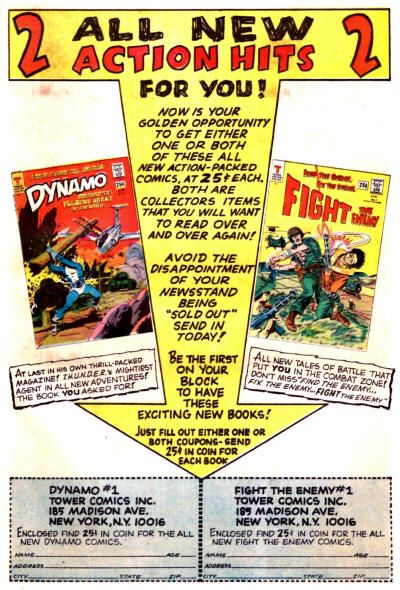
Since I have the actual Tower comic for once, I'll point out the presence of a house ad here for Dynamo #1, which you could get free with a ten issue subscription commitment to T.H.U.N.D.E.R. Agents for just $2.50. It was strategically placed after the Dynamo story, opposite an ad for Balentine Books' Edgar Rice Burroughs collection. Later in the issue, they plug Dynamo #1 again as a twenty-five cent single issue direct mail offer to "Avoid the disappointment of your newsstand being 'sold out,'" along with Find the Enemy... Fix the Enemy... Fight the Enemy #1.

Given what a blatant rip-off of the Flash he is, and how I've never liked speedster characters, I have to admit that the Lightning strip was one of the most consistent in quality of the early going. Steve Skeates, Mike Sekowsky & Frank Giacoia clearly had a solid Flash run in them, and they were all moonlighting from DC Comics anyway, but absent that opportunity they deliver the goods here. Guy Gilbert is frankly not as bright as Barry Allen by half, but his military background offers a different path toward problem solving that entertains. Sekowsky brings his wily, rocky vibe to the premise, making up for the lack of Flash Facts with shaggy dog charm and a greater propensity for violent overtures. "The Origin of the Warp Wizard" could have easily been a dog, especially with the villain looking like Doc Brown on crack in a bland all purple get-up, but he sells himself with his wry grin and mad twinkle of the eye. It's still odd though how for a dude being slowly killed by his powers, Guy never once takes the Lightning costume off and seems completely disconnected from the T.H.U.N.D.E.R. Squad. I miss them.
"T.H.U.N.D.E.R. vs. Demo" once again answers questions I'm not sure anyone was asking, but Woody seemed bound to ride herd over the shoddy continuity between the strips in the team feature through the power of the retcon. Demo's appearance in the previous issue didn't seem like it was going to amount to much more than a Gil Kane showcase, but here it becomes the spine of a key event. Having gotten a taste for NoMan's invisibility, Demo sets out to steal all of Professor Jennings' creations from the individual super-agents, which sets off a string of events that returns his girl Friday Satana in a new role and would lead somewhat to a major character death in the next issue. Where I complained about the inks of Wally Wood & Dan Adkins overwhelming others, John Giunta's dated, cluttered style benefited much from their strong influence. Demo starts a line trope here, but there's cute wrinkles in this story that later derivative works could have used.

Speaking of John Giunta, Menthor became "his" character after Sekowsky moved permanently to the Lightning strip, and it did nothing to correct the character's disastrous drift off course. Menthor was the anti-Dynamo, Len Brown being a Peter Parker-like relatable schlub who was capable of overwhelming good, but only ever reaped the whirlwind of unlucky turns and harsh criticism for his efforts. John Janus was supposedly a virtual Adonis who pleased his superiors endlessly, but his stories always seemed to pivot on his being an arrogant douchebag who loses his telepathic helmet to one dubious dope after another. In "The Carnival of Death," the mentalist Zizaqz might as well have been the Entrancer in disguise, and he wasn't even targeting Menthor for a plot-- the idiot just created a situation Zizaqz could exploit. As usual, Janus spends most of the tale trying to shake a mental whammy, recapture his belongings, and bring the bad guys in. When that sort of thing happens to Dynamo, he struggles against long odds. With Menthor, he again keeps a portion of his powers even without the helmet, and still fails at most of his mission goals. The cluttered, coarse art as inked by Carl Hubbell looks a bit like Frank Robbins, but without the idiosyncrasies that make him interesting. There are actually a few amusing turns in this script, but the character and art mute any pleasure they might have brought.

Thanks to my reading multiple chronologies of T.H.U.N.D.E.R. Agents at the same time, I almost missed Steve Ditko's debut work on the series with NoMan in "To Fight Alone." It occurs to me that he would have probably been able to salvage Menthor, who in practice was the most Randian hero of the group, but in principle was supposed to be an evil agent driven to good by technological compulsion. Can't imagine that sitting well with Ditko. Anyhow, despite a script credited to Steve Skeates, it seems unlikely that Ditko didn't have something to do with an anarchist cult leader hypnotizing upright citizens into giving up their hard earned material possessions. Even if that was already in the script, Ditko's presentation makes it all his own. Ditko seems uncomfortable with NoMan's hooded cape, and I'm not sure the glowing eyes he gains here quite work, but the mood and storytelling on display suit the Invisible Agent. There are some fantastically dramatic angles and novel techniques employed that wow, and I appreciate Tower's willingness to let the art tell the story in many silent action sequences. A strong closer for the issue!

JCP Features #1 (John C. Productions Inc., 1981, $2.00)
In rereading the Deluxe and the Archie/Red Circle comics, I realized I'd judged John C. Carbonaro's genuine contributions too harshly against the razzle-dazzle of Singer's. On revisiting this magazine, I wonder how much it contributed to that critique, since it is friggin' terrrr-ib-ble. Total amateur hour torture session. I published reviews of the fifth issues of T.H.U.N.D.E.R. Agents at the end of March, and had read ahead to review some seventh issues by mid-April. This round of reviews were written then, except for this magazine's, and trying to sporadically read it held up posting for two months! I haven't read every T.H.U.N.D.E.R. comic yet, but this is the worst that I have read, and I feel confident that when I'm done it will continue to hold its all time standing at the very bottom.

Why is it so bad? For starters, it's just cheap and shabby. There's a nice painted cover, but it's marred by the crumby hand lettering in the the large ugly yellow boxes pasted all over the piece. The inside cover editorial is typeset, and I mean it looks like someone xeroxed the template, fed the paper into a typewriter, and wrote out the editorial and indicia in one rip. There's poor hand lettering through the black & white story, with ill-advised freehand recreations of old Tower logos. The first "story" spotlights Raven, and is written by Warren editor Chris Adames. It is pure, dry exposition recapping the Tower run in a few pages, mixing hand and typed lettering. Lou Manna would go on to do decent work on the Archie issues, but here he offers a collection of ugly swipes from the old comics. He's inked by Mark Texeira at the coarse dawn of his career, though his embellishment is a highlight compared to co-finisher Pat Gabriele, a never-was with a handful of low rent credits. This is followed by a second "story," which is actually a continuation of the first, and sees a shifting of job duties to Tex pencils, Gabriele inks/edits, and a script by occasional Warren writer Kevin Duane. Ostensibly about Dynamo, it's really just a five page bridging sequence to set up the action for NoMan (mostly by the same team in the same roles.) Where the Tower stories would have been separate single stories, these are unsatisfying, disjointed chapters in one long, damp narrative.

The fourth "story" jumps the tracks so abruptly that you'd be forgiven for assuming this was a legitimate new tale. Not so fast, because creative auteur Pat Gabriele has simply dumped a Kirby pastiche space opera into the midst of the current yarn without set-up or regard for the Tower aesthetic. It looks like one of Jack's Bronze Age bombs, complete with Asgardians/New Gods, but at a fraction of the aptitude. Four pages in, Gabriele cedes the script to the unknown Richard Lynn and inks to Texeira for no apparent reason. The division of labor isn't terribly important, since the whole book is a hash of hoary corporate comics cliché, purple prose, and clunky hand-me-down art diluted by too many chefs. There's no vision and little style, plus it's humorless and charmless in direct opposition to what made the Agents stand out. It's so flavorless that I find myself tuning out as I try to read, like it was a textbook on a dull subject.

I lost track of where we were. Installment six? Lightning? Yeah, or course Guy Gilbert whines about his impending death due to his usage of super-speed. It isn't the scripter's fault that this same scene would play out in nearly every Agents comic until the character was finally dropped in the late '00s, but the only thing added to the lot was Lightning's being able to run from Earth to outer space thanks to "newly designed antigravity gloves." Even in comic books, the suspension of disbelief has its limits.

For thirty-some pages that feel like twice if not thrice that, the Agents exposit or numbly battle inconsistently drawn aliens (reptiles? subterraneans?) and robots while mouthing off crap to fill up space. Then the tiniest of big bads turns up on the last few pages, there's an explosion, and the story ends with... another dialogue balloon of exposition and a crap line from Dynamo to fill space. Oh, and a third of the final page is devoted to a horrible sketch by Kelly Freas of Pat Gabriele offering a brick of typeset words of acknowledgment. Following were a two page reprint excerpt of a Fly story by Simon & Kirby and a ten page Black Hood reprint by Morrow, Adams & Giordano. Just to remind you how professionals do things.


T.H.U.N.D.E.R. Agents #6
(DC, 2011, $2.99)
Worst issue of the series to date. Wally Wood didn't seem to have a problem with illustrating extended sequences of people in offices wearing business attire discussing stuff, but that always gave way to something exciting, usually involving cool looking things having knuckles smashed against their mouths. By comparison, Nick Spencer is a pleasure denier. All of the key action in this issue takes place off-panel, and much of the issue is devoted to characters explicitly not even discussing what happened. Seriously-- characters bring stuff up, and then other characters just say "tut-tut-- mum's the word," and then there's some nudging and winking. Like, six instances of that, and then an Arkham City sneak preview starts. Cafu & Bit illustrated the entire issue this month, so I didn't catch what I guess was an anti-climax to the main story, followed by an Iron Maiden five-pager that also ends so abruptly I was all "whaaat" when Batman and the Joker showed up-- rifling the pages looking for an actual conclusion to the issue in hand. Nothing happens in this issue but characters staring at their navels over stuff the audience only sort of get having happened, and then Iron Maiden rips off the Wonder Woman in Vietnam segment of The New Frontier.


T.H.U.N.D.E.R. Agents #6 (IDW, 2014, $3.99)
Phil Hester has fun reimagining and critiquing a Silver Age villain, which translates to the page. I'm still enjoying the art of Roger Robinson, which I can take more seriously than the book's previous toycentric look. I'm digging most of the redesigned Agents, though I'm still struggling with Robo-Dynamite. A new "old" Agent gets introduced that checks two boxes on the Equal Employment Opportunity questionnaire, and while a bit self-righteous, she's still an improvement over other recent attempts. Can't get behind Weed's altered look though, and in fact he reminds me more of Perez's Raven than a character Woody modeled after himself. Body type is another path for diversity, and all these agents are too uniformly buff. There's a modest undercurrent of political commentary, and subplots brewing, that make this volume seem like it's catching up in quality to the DC incarnation without the vaporous decompression that hurt that run.

Returning to the theme begun last review of Andrew Currie sucking on the Subscription variant cover, this no background having, altogether incomplete group shot added insult to injury by not even being colored. I ordered this sight unseen, which will not happen again. Friggin' IDW is on my list, man!


Tuesday, May 27, 2014

The Walking Dead Volume 20: All Out War, Part One (2014)

I read this trade a month or two ago, but put off writing a review because of general life fatigue and because it just wasn't an important thing for me to do. With the announcement of the bi-weekly arc "All Out War," the series gave me a jumping-off point, so we're in lame duck mode here. The series has always been a bit of a western, but has taken on a few war feature tropes, though processed through a Road Warrior filter that renders it cheesy and half-assed. This volume starts with a gentle wading in chapter, establishing where our heroes and their relationships sit at the eve of war. Then comes the first big gambit against our villain, Negan, which is half clever/half obvious. It's nice to see the good guys take an early advantage and undercut the seeming infallibility of Negan, but we all know that won't last, because, y'know, Rick's the leader. The war continues on other fronts with the idea of building up Rick's rep, but this is done through highlighting the incompetence and cowardice of leaders who are not Rick, so that we know he's at least the best of what's around. The worm turns, bad things happen to nothing characters, and our heroes return to underdog status by the chapter break.

While we're waiting for the wrap-up, how about that fourth season? The mid-season breaks are always strong, but that show sure meanders on the back half, huh? Thankfully, the writers were wise enough to tear their focus away from Rick and Carl to show us how other survivors dealt with the fall of the prison. That led to "The Grove," one of the series' best episodes, which was both faithful to a comic book storyline and built upon it magnificently through the twisting relationship of Carol and Tyreese. Others fared worse, like I'm now hoping the sickening codependency of Glenn and Maggie ends with their grizzly deaths. The jarring cosplay of Abraham, Rosita and Eugene sure was distracting. The shipping of Daryl and Beth was sweet though, and I still like wholly original supporting players Tara, Sasha and Bob Stookey. Finally, good to see Jeff Kober getting work, and the more organized Terminus was a solid deviation from the comics, though the show has suffered from excess fidelity of late. The closer it gets to the comics post-prison, the deeper it enters the territory that has me ready to stop reading.

And we're back for "ALL OUT WAR!" Meh. I do like Stefano Gaudiano's inks in this environment, adding a crispness and clarity that suits the more action-adventure tone of this arc, though it occasionally becomes so sharp and flashy as to reveal its Image roots. If I'm thinking about Cyberforce and Pitt during your "realistic zombie apocalypse," something may have gone awry. Charlie Adlard is still great at grounding the action though, even as the horror is lost amidst the flash-bang and soap opera. As has been the case for some time, the problem with the book is Robert Kirkman-- too enamored with empty spectacle to spice up plodding plotting; having lost faith in his zombies and divided his attention to oversee (and I hear micromanage) his empire. The new characters don't stick in the mind, while the old are wearisome and tainted. I can't imagine a way for this to end well, in the sense that there's anything to make me change my mind about leaving. To quote the show, it's too far gone to ever come back...

Tuesday, May 20, 2014

Sex Criminals, Volume One: One Weird Trick (2014)

I find it strange and a bit disappointing that Image has released two buzzy series in the past year whose titles start with the word "Sex" and neither is especially sexy. It's also strange that Casey & Kowalski's SEX is listed under the genre "Romance / Drama" where it feels more like crime fiction, while Matt Fraction and Chip Zdarsky's Sex Criminals reads like a quirky romantic dramedy, but is listed as "Science Fiction." Sex Criminals spends a lot more time exploring human sexuality and its emotional resonance, but aside from scenes in an adult boutique of comparable explicitness to Neighbors, it's reasonably safe for all but the most prudish readers. It's a lighthearted look at the early stages of a relationship with echoes of broadly accessible Japanese sex comedy (say Rumiko Takahashi) and/or John D. MacDonald's The Girl, the Gold Watch & Everything.

Sex Criminals is much more readily enjoyable than Sex (or, yeah, just plain enjoyable as entertainment at all) but it's also, frankly, base. The characters are relatable millennials who, having grown up with the internet, are comfortable with appliances of pleasure and discussing common kinks. The characters come together because each can access the ability to temporarily halt the progression of time through sexual gratification, and they use their powers to rob banks, but it's okay because it's all for a good pro-literacy/anti-corporate cause. Despite featuring early adolescents rocking a tub faucet, frozen midair ejaculate, and glowing penis wands, it's all amazingly safe for your average HIMYM viewer. It's breezy and mildly amusing, but I'm clearly not the target audience, because I'd rather spend more time in miserable Saturn City than continue to pleasantly, passively bop along to a mash-up of Trancers and (500) Days of Summer with dildos.

Wednesday, May 14, 2014

SEX Book One: The Summer of Hard (2013)

Growing up poor and nomadic, I embraced television, comic books and action figures to an unhealthy degree. These were, after all the "relationships" I could afford to maintain and carry with me wherever my shitty deadbeat parents dragged me. By the late '90s, I'd put away my toys, but running a comic shop scratched that itch, and I traded out TV for a pathetically large attention investment in the internet. Outside of DVD sets, my estrangement from television held through the aughts, but the rise of high quality cable offerings finally drew me back to weekly television.
My interest in a lot of these shows could readily be shared with others, but my regard for Mad Men was more isolated. Where something like True Blood was a lightweight confection ideal for marathon/party viewing, Mad Men was a heavy, filling drama that was difficult to sit through much more than an episode at a time. I was recently talking to one acquaintance who found himself stalling out in the second season, and asking me if it would get better. In terms of storytelling quality and advancement, it certainly would, but in terms of the existential angst and suicidal depression it wallowed in, no it would not. It's a show set during the initial crack-up of the "golden age of white Americans," centered on deeply unhappy people whose identities hinge on their performance in an industry of generating falsehoods. Total red wine and sleeping pills in the bathtub viewing.

Presently, my connection to the comic book universes have been strained, so I've been seeking out more esoteric fare, to mixed results. Just as when I was getting back into cable TV, I've sampled a lot of stuff, and appreciated their more loose morals, but too often found that the material wasn't all that different from what's driven me away from the mainstream. For instance, I never really warmed to the notion of mutant brothels in the X-Men books, or the self-consciously "cool" writing of Joe Casey in general. His moving into creator-owned works and fully embracing his gratuitous inclinations on a book like Sex is more palatable to me than his efforts at DC & Marvel, but the debt he owes them is readily apparent. Audacity has its merits, but it isn't near as rewarding as originality.

Sex, Vol. 1 is basically the scenes from Watchmen involving Nite Owl and Silk Spectre in plain clothes pining for their glory days extended for eight long issues at a very affordable $9.99. Filling the extra space is loads of Howard Chaykin and Frank Miller pastiche achingly familiar to readers of late 80s/early 90s "mature graphic novel" sludge-- the Moore Wave/Post-funk era of comics. Not-Batman is in a po-faced malaise after promising a dying not-Leslie Thompkins to give up the cape and cowl. Not-Bruce Wayne suffers through anhedonia while intentionally exposing himself to graphic sexuality while drifting through a "real life" not of his choosing. To assist with the amorous in nature but not in elicited response imagery, a prematurely aging not-Selina Kyle runs a whorehouse, where not-The Riddler seduces one of the girls. The only action pulse comes from the rougher side of town, where "Urban" Jason Todd is still trying to mete out street justice to That Yellow Bastard, The Calculator, and Heckle and Jeckle.

While it's a goddamned shame that so much of the super-hero genre is so nakedly dependent on tarted up blatant swipes of corporate IP, Sex seems to aim outright for melancholy in a familiar milieu. Mad Men owes as much a debt to filmmakers of the '50s & '60s as it does to Matthew Weiner's fuzzy half-memories of life in that era. Donald Draper is hounded by his compulsions toward self-destructive adultery and other debauchery, but Mad Men has never been interested in glamorizing those inclinations as playing out the emptiness and psychic wreckage that comes with it. In spite of the appealing and often naughty art of Piotr Kowalski, Sex is in no way about getting the audience off, and is in fact a denier of pleasure. The book reads like a condemnation of the '80s avant guard in comics, as though a young Joe Casey followed them like an apostle, only to find their nihilism and judgment of earlier creators' naive works led him to a place where he could produce such a joyless, defeatist book as this.

I can't say that I enjoy Mad Men much anymore, but I'll follow it to the unquestionably bitter end in 2015, as it warrants viewing, analysis, and measured praise. For what it's worth, Sex is something like the Mad Men of modern comics, whispering in your ear during a viewing of Pillow Talk that Rock Hudson's really a queer who's going to die of A.I.D.S. in the end. I can't exactly recommend Sex, but there's enough of admittedly bleak interest here that I'll commit to at least slog through a second volume.

Thursday, March 27, 2014

A Fifth of T.H.U.N.D.E.R. For All Anyone Cares #184

T.H.U.N.D.E.R. Agents #5 (1966)
T.H.U.N.D.E.R. Action #2-4 (1986)
Wally Wood's T.H.U.N.D.E.R. Agents #5 (1986)
T.H.U.N.D.E.R. Agents #5 (2011)
T.H.U.N.D.E.R. Agents #5 (2014)


So here we are at the fifth issue and, well, the novelty is wearing off. As I've mentioned in the past, I got into the Agents through the short-lived Deluxe Comics series, and only read the Tower books as highlight reprints or sporadic bargain low-grade back issue finds. Reading five different incarnations a month in their individual chronological order in a manner closer to how they were released has given me insight into why the T.H.U.N.D.E.R. Agents have consistently failed in the marketplace.

T.H.U.N.D.E.R. Agents #5 (Tower, 1966, 25¢)
"Dynamo and the Golem" starts off this issue with unsure footing. Reed Crandall was a great artist even before he was thoroughly processed into the house style by inkers Wally Wood and Dan Adkins, but a consequence is that his story looks more like slightly off-model Woody than its own thing. The script has a similar issue, with masked terrorists, Subterranean Warlords and a behemoth for Dynamo to fight. All the expected elements are there, but they don't play out correctly. Len Brown doesn't struggle with the mundane trials of his job before finding relief in physical conflict. Instead of sarcastic asides, Dynamo has a completely silent punch-out for seven panels sandwiched between flat expository dialogue (followed by more cycles of the same.) Dynamo is perhaps too competent, recalling Menthor as that character shows up and falters in a cameo, swapping hats. The story even ends back at HQ with Alice Robbins, but with propagandistic sloganeering replacing romantic misunderstanding/petty bickering. Aside from the lovely visuals-- hell because of them-- the tale brings to the fore the Dynamo formula of coming up with goons for the hero to toss around and something big for Len to punch without much regard for logic or nuance, simply coasting on visuals. For a character only a couple of months away from having to support his own giant-sized solo spin-off title, this tale underlines how little creators have to work with there in the absence of the Woody sheen.

NoMan "In the Caverns of Demo" has a few more surprises, not all of them good. The famed Gil Kane returns for the first time since the debut issue on a different strip, and while it's still a looser, lesser job, Kane suits NoMan better. Demo also returns to become NoMan's first recurring foe, and his presence is set up through a retcon that backs up Iron Maiden's situation in the previous issue. You get a strong impression of how momentous T.H.U.N.D.E.R.'s defeat of the Warlord was in the second issue while simultaneously making clear that G.I. Joe already beat their Cobra and have no one substantial to fill that void. Further, there's no reason Demo specifically needs to be in this story beyond it dispensing with set-up and affording fan service continuity clean-up. The island of "barbaric sub-breed" humans could only have been worse if they were not unambiguously Caucasian (this time.) It's an okay adventure with solid art, but rote in a title becoming defined by being rote.

Dan Adkins provides a peachy pin-up/dossier entry for Lightning, which seems like a precursor to Who's Who/OHOTMU. It contrasts sharply against the Lightning story that follows by Steve Skeates, Mike Sekowsky & Frank Giacoia. In their forward to T.H.U.N.D.E.R. Agents Archives Volume Two, Robert Klein and Michael Uslan noted that the Lightning strip was the closest to standard super-hero fare and was created under the greatest autonomy away from Wally Wood's editorial eye. Put more critically, it was bog standard for middle rung DC of the early Silver Age, not inventive enough for Julie Schwartz, but maybe a decent effort out of George Kashdan's office. No one should be impressed that Baron Von Kampf is already back. Oh hey, I just got that. Since he's Lightning's first recurring foe, would Guy refer to him as "Mein Kampf?" Speaking of Guy Gilbert, his being in the suit seems of no consequence to the story; sub-Flash fare without reference to the T.H.U.N.D.E.R. Squad or even what Guy looks like under that mask. Mediocrity runs so deep that the Lightning logo can't escape falling below standard. Sekowsky's idiosyncrasies are the only saving grace here.

"Menthor vs. the Entrancer" proves the general rule that the worst written story of any given issue will probably star Menthor. John Giunta isn't stingy with panels per page, especially during the villain's origin sequence, but his style is a tad dated and the story being told feels like a throwback to the late Golden Age. The Entrancer is a thuggish lift of Doctor Strange, which by T.H.U.N.D.E.R. bad guy standards is rather advanced developmentally, but he comes to a limp end in a dull yarn. The basic premise of John Janus being an evil double agent stymied by his helmet seems to have been forgotten, and his supposed role as most qualified T.H.U.N.D.E.R. Agent is undermined by mistakes and dependency here. It doesn't help that there's no consistency in his creative pool from month to month. Remember how Janus now has powers even without the helmet? Neither does the scripter. Between his highly derivative costume and the lack of investment in the character behind the scenes, it's no wonder that telltale zero on his brow is starting to look more like a target bullseye.

"Double for Dynamo" closes out the book with a team feature, and makes clear that kids were paying twice the standard comic book cover price of the time for this story and a bunch of ballast. Steve Skeates continues along the thread started in his NoMan story of last month with a frantic search of T.H.U.N.D.E.R. for android replacements. It's too bad for the promising premise that they have a reliable detection method in place from page one, and that no one of consequence was found to have embedded themselves in the agency. The Mastermind is a bit of a goofus nogoodnik who literally does a bellyflop before this whole affair resolves. He's outclassed by his masked minions, who looked to have inspired the Black Spider from '70s Batman comics. The tale is light entertainment drawn by the Wally Wood studio, and the main takeaway is that the T.H.U.N.D.E.R. Squad's Weed was being actively groomed as a street smart sidekick for Dynamo.

T.H.U.N.D.E.R. Action #2-4 (Savoy, 1986, 75p)
Once again, I've never had copies of these books in my hand, relying solely on the internet for my reading pleasure, as can you. Aside from badly (and likely illegally) reconstituted British Tower reprints, the final issues of T.H.U.N.D.E.R. Action also offered two full color (colour?) newly (amateurishly) created tales by artists Eddie DeVille and Jon Sussex. The NoMan feature is brief with a predictable non-twist (and an unforeseeable panel of gratuitous nudity. Blame Page 3.) The Dynamo & Iron Maiden story echoes Menthor's closing comment from the fifth issue of the Tower run, "You may not be smart, Len... but you're sure lucky!" Both stories are actually fairly inventive for three page filler. Why everything has to take place on private islands off the coast of New England, I don't understand.


Wally Wood's T.H.U.N.D.E.R. Agents #5 (Deluxe, 1986, $2.00)
I have yet to replace the copy of The T.H.U.N.D.E.R. Agents Companion I ordered a few months ago, only for it to "mysteriously disappear" at my old shipping address, but I do have other Twomorrows magazines lying around that covered some of Deluxe Comics' scams. I used to defend David Singer based on his own line of bull and superior product versus Carbonaro, but on further inquiry, he seems to have been super shady. His last editorial page in the final published issue of Wally Wood's invokes Nixon by name, which would be damning enough. Following this with a Jerry Ordway illustrated story that throws several Agents under the bus to promote awful seeming Codename:Danger characters in a never-to-be-finished crossover is itself a criminal offense. Ordway is the most obvious and potent direct inheritor of Wood's artistic DNA, and for fifteen pages we visually received the finest revival the Agents deserved. However, the story is lame, waving away what should have been a continuation of a previous subplot with a line of dialogue, and setting up new threads to dangle forever. It's a shame, especially since Roger McKenzie's script pops when he's not tripping over Singer's junk, and even Paty's coloring steps up.

There's an all-text advertisement for 1987 Honeymooners and Buckwheat calenders offering "trivia, dates of importance" and such for just $9.95 shipping inclusive ($20.56 in 2014 dollars.) Even accounting for Eddie Murphy's years old series of Buckwheat SNL skits, even if somebody would have wanted these things in 1986, could there have been a worse way to advertise to them than an all-text page?

The Lightning strip goes out as it came in-- an abomination. The serial killer "mystery" is solved through the revelation of a previously unseen figure from Guy Gilbert's past that thinks in heavy exposition with a bad "accent." In case you were concerned that the misogyny might lighten up, no worries, a lovely professional is hideously disfigured and her eyeballs gouged out (partially) off-panel. Keith Giffen continues to cut as many corners as possible to lighten his workload with barely comprehensible narration full of extreme close-ups, shadows, stats, and general abstraction. The Bierbaums' script continues to anticipate the demeanor of message board trolls. Nothing is or will ever be resolved to anyone's satisfaction, but at least I don't have to read this anymore.

Singer is joined by Mike Harris for a cheeky, copyright flouting Dynamo lark that tries to near literally treat the character as a Superman clone in the fashion of Christopher Reeve. The Big Two pseudo-cameos at a costume party aren't appealing, but it is fun to see period obscurities like Grimjack, Sable, Aztek Ace, Thunderbunny and so on. Still hard to see the point, as it isn't exactly funny, nor is it a character study, and it certainly isn't exciting.

The capstone on the run is yet another Dynamo tale that doesn't do the property any favors. The creative team behind the minor black & white boom hit Ex-Mutants; the now forgotten Anthony Pereira, John Statema and Mike Witherby with '90s Marvel poster boy Ron Lim; offer an inane yarn seemingly designed to fill as much space with as little of consequence as quickly as possible. Ignominious indeed. Say, did you know Rob Liefeld, Jim Balent and Dale Keown used to do covers on that series in their early days, and it launched Paul Pelletier's career? Marvel owns that now, right? I don't remember it being all that great, but you'd figure if it was still on the market, somebody would have done an omnibus by now.


T.H.U.N.D.E.R. Agents #5 (DC, 2011, $3.99)
This series is frustrating. It's telling one of the most sophisticated and involving stories of the lot, but doing so in the least satisfying manner episodically. For instance, this issue has a five page flashback sequence well rendered by Ryan Sook that serves up needed exposition. The rest of the book is another strong showing by Cafu & Bit where pieces set up in previous issues finally begin to click together. Then, it just stops, again. Every month, about the point where Nick Spencer has ratcheted up your interest, he breaks off to have a smoke and stargaze. He's screwin' just like a Chinaman.


T.H.U.N.D.E.R. Agents #5 (IDW, 2014, $3.99)
I think this was my favorite issue of this run so far. I previously had trouble getting past Andrea Di Vito's high-end licensed toy comic visuals, where new artist Roger Robinson is more of a storyteller. Robinson isn't as polished, but he brings mood and more varied angles. Colorist Rom Fajardo is still swell, but he seems to be taking greater license with his contributions, adding digital squiggles and other bits of personal panache. With the main characters established, there's a greater sense of their moving toward an overarching story, rather than being pieces of P.O.V. in a perfunctory scenario. I also like the nods to Tower, playing on reader familiarity to create foreshadowing, but in the present enough not to lose new readers. I do have one complaint. I've been buying the Subscription variants, which tended to have bigger name artists and play with the classic incarnation more often. With #4, I bought two copies, so I could make use of the blank sketch cover this convention season. Starting with #5, Andrew Currie has taken over the Sub covers, and it's plainly inferior to Robinson's standard cover. It's so bad that I might have to rethink my buying habit.

Thursday, March 13, 2014

“Strange Tales” by Steve Garcia


Nick Fury A, B

Doctor Strange A, B

I was also inspired to put one of my own together, derived from the art of Kevin O'Neill...


“We Can Be Heroes”

...nurghophiles...

Blog Archive

Counter


Surrender The Pink?
All books, titles, characters, character names, slogans, logos, and related indicia are trademarks and/or copyright of their respective rights holders.