Monday, January 13, 2014

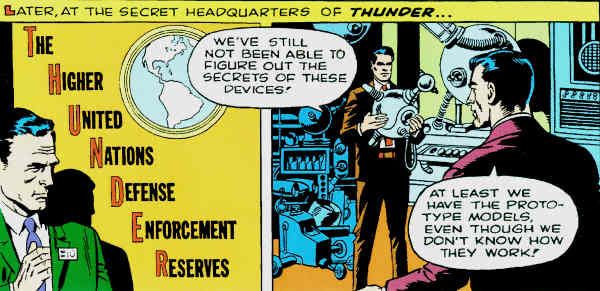
Wednesday is a Third of T.H.U.N.D.E.R. For All Anyone Cares #182

T.H.U.N.D.E.R. Agents #3 (1966)
Blue Ribbon Comics #12 (1984)
Wally Wood's T.H.U.N.D.E.R. Agents #3 (1985)
T.H.U.N.D.E.R. Agents #3 (2011)
T.H.U.N.D.E.R. Agents #3 (2013)


T.H.U.N.D.E.R. Agents #3 (Tower, 1966, 25¢)
"Dynamo battles the Subterraneans" opens with a boss splash and a page that uses Len's boss to explain why working folk should hold Brown dear to their hearts. Dynamo is no James Bond-- just a capable regular guy put through the wringer by his employers for suffering the exact same whims of fate as most super-heroes. I also adore the "of its time" aspects, like references to '50s sci-fi/military programs or something as simple as Len's blazer. The story is too brief for the stakes, but it leaves you wanting more. Dan Adkins' pencils look enough like Wally Wood after embellishment that I couldn't tell any difference.

The handicapped villain in the NoMan segment would be more novel if you weren't distracted by the off-color joke possibilities of Vibraman. Maybe that's why it was reprinted in the last issue of the Tower series, which I picked up years before the DC Archive Edition was available to me. There's some nice bits, including a new wrinkle to NoMan's abilities. John Giunta's pencils are clearly more staid, but Woody and Coleman ink him back to model.

"Dynamo and the Menace of the Red Dragon" had the same creative team as the first tale and was also reprinted in T.H.U.N.D.E.R. Agents #20. It was in fact the last story Tower printed in the series, so it has a ringing finality in my mind that isn't reflected by its true chronology. Until I reach the true end of the series through these reviews, I guess "my" Agents ends with Len going out on a date. My sad little anecdote aside, I can't decide if it was topical or in poor taste that Dynamo goes to "Vietnesia" to save the superstitious soldiers from manipulation by the Commies. I wish the Red Dragon had been built up more, because I liked seeing an Agent battle a costumed foe on an even keel without somebody looking ridiculous. One thing this series was great at was multi-panel sequences that build up a moment, so that you don't forget the sense of wonder that comes with the Agents' powers.

Throughout the issue, there are pin-ups of the individual Agents that list basic details like physical features and abilities, a forerunner to Who's Who and OHOTMU. Each is sweet, though it's curious that Professor Dunn had a bust in his as a reminder of what he used to look like, but Menthor isn't shown without his mask. The T.H.U.N.D.E.R. Squad had a group picture, then head shots with a short paragraph about each member. A page is also spent exploring the Thunderbelt.

"Invaders from the Deep" definitively moves me toward "poor taste" with regard to the handling of Asians here. They don't quite speak Pidgin English, but it's clipped in ways that come close. While the Dynamo story had reasonable facial features and skin tones, this one has Guy Gilbert volunteer his team to appear in black yellow grayface with Conan wigs and island skirts to foil a Nazi working with the Red Chinese. It's gross.

I was looking forward to "Dynamo vs. Menthor" going in and getting the full Marvel treatment, but felt robbed coming out. The "twist" was heavy handed up front, and Dynamo went down quickly, so it was more like "T.H.U.N.D.E.R. vs. Damage Control," hold the NoMan. Wally Wood being finished by other artists isn't as satisfying as Woody finishing them, and there was some wheel spinning. I did like the one panel where all of the current T.H.U.N.D.E.R. heroes are called before a council, though.

Blue Ribbon Comics #12 (Archie, 1984, $0.75)
Inker Willie Blyberg proved himself yet again with a swell cover all his own (and I couldn't help noticing parallels to Dave Sims' variant cover on the second IDW issue.) The interiors as penciled by Paul Bonanno are not as strong, but there are some solid money shots. On that note, the new Menthor's costume not only leaves her ass cheeks hanging out, but she's first pictured from behind and only wraps the exploitative poses once she's forced into an armored variant. The giant insects problem is solved much too easily, and then the real enemies show up with old continuity to prove they're 2Legit2Quit. Then they quit, because there's only 18 pages to clear out what would have been the JC Comics ongoing series in a special guest spot in what was normally Archie's solo Mighty Crusaders anthology. The opening premise had its meta-merits, but the new designs were leftover disco era casualties, and the whole affair was as underwhelming as the rest of the Archie Adventure Series the T.H.U.N.D.E.R. Agents were retroactively connected to.

After what I think was a fan letter from comics manly man Beau Smith, there's a ten page NoMan solo story drawn by Steve Ditko that should not have been written by Charlie Boatner, who only has nine non-JC credits to his entire comics career. Actually, it's a solid Dr. Moreau riff. I'm just pissed for all the name writers that would have loved to have worked with Ditko and never had Boatner's chance. Blyberg makes it one of the best looking post-prime examples of Ditko, with Bubastis in a pre-Watchmen cameo.


Wally Wood's T.H.U.N.D.E.R. Agents #3 (Deluxe, 1985, $2.00)
David M. Singer's editorial covered the legal dispute over the property rights from his colored but colorful perspective, which was brave for ongoing litigation that was affecting the publication status of the book. Deluxe was getting a lot of negative press, but Singer does his best Stan Lee to minimize the damage and hype his product. It gets a bit too fannish once micro-reviews of Misfits of Science and Maxie pad out the back end, though I'll always congratulate a recommendation for The Comic Book Heroes.

After my backhanded comments about Dave Cockrum in previous issues, he showed up here to remind me that T.H.U.N.D.E.R. Agents was always at its best when driven by artists. Cockrum took over the scripting chores, resulting in a read that no longer feels like a chore. There's an anachronistic abundance of purple prose captions and gratuitous dialogue for 1985, but Cockrum embraces the right kind indulgence, with lots of cute character asides and intriguing foreshadowing adding value to the feature. Everybody expects artists to cut down on the verbiage, but they often seem to have so much pent up to say, it explodes. Cockrum throws a whole bunch of ideas out, setting up new characters and situations while enlivening those previously established. Most importantly, he's having fun, which translates to reader enjoyment.

John Workman provides a Phoenicia pin-up, recalling recent discussion of his rare moonlighting from lettering on WHO’S WHO: The Definitive Podcast of the DC Universe. I think it's swell, but a little weird to do a sexy drawing of George Pérez's wife, fictionalized or not.

I usually love Keith Giffen artwork from his Muñoz period (note to self: why haven't you read Muñoz yet?) but the Lightning strip features some of the worst of it. For instance, there's an ugly heroic splash on page two with a Liefeldesque disregard for lower extremities not remotely helped by a blood red border. Women are violently (and vilely) murdered across facing pages, but the storytelling and transition are so oblique that it took me a minute to figure out that there were two separate victims in two distant locations. Another splash, illustrating an explosion in a nondescript space involving only silhouettes of debris and an over-sized sound effect, fills a page while shabby exposition is left to explain its effects. The final page involves four small panels swimming in ugly purple negative space. There's a few amusing moments on one page that are in the T.H.U.N.D.E.R. spirit, but mostly Giffen and the Bierbaums succumb to the worst, most mean-spirited instincts of the day. It's kind of amazing they let him near Justice League after this, or perhaps, sadly not.

L.E.T.T.E.R.S. was kinda nuts, as four pages of bricked text communications unbroken by illustration gets heavy. Kim Thompson and Tony Isabella offer short missives, but it's mostly fanboys going on and on about the promise of the characters, the quality of the creators, and... paper stock/content-to-editorial-to-advertising ratios? Singer also has T.M.I. issues, with responses running as long as letters that involve cross-promotion and spoilers (Lightning to exit/die in #8; new Menthor to hit in #9, etc.) That could have deflated the book's momentum if it had survived past #5, but as it stands, I guess it was nice to know where they would have gone.

Finally, Steve Ditko returned for another NoMan story at a different publisher. Greg Theakston faithfully inked Ditko, probably with too much fidelity, since it's stiff and so light on detail that it looks like a licensed adaptation of an animated series for Star Comics. It's not bad, just simplistic. The story by Stephen Perry is alright, but there's not enough to justify it as a two-parter, and the Chief speaks to "Tony" in an overly familiar fashion. I do like the contrast to the treatment Len Brown received, though. I could also have an easier time seeing the play on the legend of the cyclops as clever if it hadn't been rendered through "Cyrano de Klopps." Ugh.


T.H.U.N.D.E.R. Agents #3 (DC, 2011, $3.99)
NoMan is my favorite Agent, because he had the coolest look, neatest power set, and most inventive stories. This has been my least favorite of the Spencer issues so far, because he's writing Dr. Manhattan, the dullest of the Watchmen. The whole issue is dour and secretive to the point of being obtuse. It's too bad, because Cafu's art is especially nice this month, and the flashback material by Howard Chaykin looks like it was more fun to draw than to read. Also worth pointing out: three issues in, and half the characters on the cover haven't been properly introduced.


T.H.U.N.D.E.R. Agents #3 (IDW, 2013, $3.99)
I'm still put off by how old school conventional this series is, compared to the bolstering of the Agents' innovative esteem that the DC book managed. It's a late '70s Marvel team book played at half speed, but creatives Phil Hester and Andrea Di Vito are too agreeable to gripe over. I like most of the appropriated and tweaked character designs, though Iron Maiden's streamlining smooths out the edges just when she needed them most (plus her re-history stinks up the joint.) I do like the steady, appealing reintroductions of the cast though, and there's a great bit involving NoMan toward then end that would have fit right in at Tower.

Monday, December 2, 2013

Wednesday is Seconds of T.H.U.N.D.E.R. Agents For All Anyone Cares #180

T.H.U.N.D.E.R. Agents #2 (1966)
T.H.U.N.D.E.R. Agents Vol.2 #2 (1984)
Wally Wood's T.H.U.N.D.E.R. Agents #2 (1985)
T.H.U.N.D.E.R. Agents #2 (2011)
T.H.U.N.D.E.R. Agents #2 (2013)


T.H.U.N.D.E.R. Agents #2 (Tower, 1966, 25¢)
As much as I enjoyed the debut issue, the game steps up here. With all the exposition dispensed with, Dynamo visibly leaps into action from the first page. A romantic subplot is introduced, and Len Brown gets dressed down in a way unheard of in period comics. The Warlord is revised by Wally Wood into a darker, more mysterious foe. Wood also takes back his crown as master of beautiful women with the smart and capable Alice Robbins. The physical threat is presented by Dynavac, his garb alluding to medieval torturers/executioners, marking his as a creepy, intimidating presence. He also strongly recalls the initial appearance of Doomsday to such a degree that I'd be surprised if DC hadn't taken a cue from Tower in his design. An exciting story with a twist ending uncommon even today.

NoMan continues to be my favorite strip, thanks to the wildly inventive application of the hero's powers and vulnerabilities. It's also tough to go wrong with an army of "zombie" soldiers for NoMan to toss about like he was channeling Kirby Captain America. My only complaint is that the art by Ayers, Orlando and Wood removed the shadowy dread of Crandall's initial strip.

There's no writing credit on Menthor, but I wouldn't be surprised if Mike Sekowsy was learning his craft on the script himself. There are a lot of amateur mistakes and crazy logic leaps, but the overall feel is reminiscent of his later DC work on Wonder Woman and "Manhunter 2070." It's still fast moving and fun, just with an element of Axe Cop insanity.

Dynamo triumphs in the second half of his story, with striking imagery and a major reveal that thankfully wasn't drawn out, though the resolution was a tad pat. Then there's a text story, "Junior Thunder Agents," which offers a flimsy manual for kids to form their own local fan club and immediately begin having irresponsibly violent adventures involving teen gangs running protection rackets. The big book wraps with T.H.U.N.D.E.R. Squad taking on a straw Cuba and cavalierly losing a member who surprisingly wasn't one of the two brunette males who happened to be rendered nigh-indistinguishable in the story by gas masks. That would haunt them later, not least for it spawning decades of morbid self-pitying monologues from Guy Gilbert. My favorite part was the random inclusion of a nuke-spawned gillman. Well, that and Kitten in yoga pants. She also had the. best. hair.


T.H.U.N.D.E.R. Agents Vol.2 #2 (JC Comics, 1984, $1.00)
The second and final issue of this incarnation picks up and more briskly advances the story from the debut. Dynamo battles a big purple monster type thing that never gets explained, then teams up with Iron Maiden in the most predictable fashion, given the "couple's" history. Wally Wood's Agents meet Wally Wood's Mars Attacks giant insects, plus some weird celestial overlord works from the shadows, recalling Steranko S.H.I.E.L.D. Ronald Reagan worshipers may want to check out his notable cameo. The female Menthor continues to be teased, and would be the worst copyright infringing element once Deluxe and Solson Publications tried their bootlegs. Vulcan was properly introduced instead, as a sonic blaster slowly growing deaf, and a second whiny bitchboy love interest for Kitten Kane, the poor dear. Most of the Agents have a spotlight of some sort, but I got the biggest kick out of the grizzled Squad, with Weed getting the best comic relief moment. To be continued eight months later in an Archie Adventure Series anthology...

Charlie Boatner's dialogue doesn't improve much on Chris Adames', but the overall tone lightens to make the mayhem more of a romp in the vein of Woody. Lou Manna and Paul Bonanno split pencil duties, but the art star is Willie Blyberg, who keeps the look consistent and enriched by lavish inks. Murphy Anderson supplies a nifty centerfold "poster," there's a fun gag image by "Maurizio," but my favorite was the unsigned back cover featuring Iron Maiden.


Wally Wood's T.H.U.N.D.E.R. Agents #2 (Deluxe, 1985, $2.00)
David M. Singer offers even more editorial text this month, with both candor and pomposity. The personality sure set the line apart, though.

Dann Thomas' Raven script was better this time, as it toned down the purple prose and focused on providing the origins of the hero's relationship with the nefarious Phoenicia. It was difficult to read for a new reason-- production errors rendering some of John Workman's lettering nigh indecipherable. I like Craig Lawson's design more than Raven's, as he recalls Adrian Chase. The art was more consistent, with Bill Wray doing a decent job over Perez's layouts, but their styles weren't the most compatible.

Tom & Mary Bierbaum made their writing debut on the Lightning story, and for a character history summation with transparent foreshadowing, it was okay. Since there's virtually no action and a lot of repeating panels, Rick Bryant has an easier time with Keith Giffen's pencils. The interaction between the two featured characters is inorganic, but the story does begin to pay off a long in waiting subplot.

There's an ad for "The Deluxe Comics Line of Designer Posters" that you could send away for, but in an example of slitting one's own throat, the Perez Menthor one is a pin-up in this issue, and George's Iron Maiden is used as a centerfold. I'm sure the full sized posters were nicer, but these would do in a pinch, right?

Finally,the team story by Steve Englehart and Dave Cockrum, which remains the weakest link. It's improved by focusing on Lightning, though it covers much of the same ground as the Giffen story. There's no line of dialogue spoken when it could be shouted hysterically at other characters. The story has tonal issues, since it seems to be taking Lightning's deterioration seriously, but then drops in a moment of broad comedy in the midst of the heavily whipped pathos. The result is neither sad nor funny, just kind of dumb, and the grandstanding on display wore out any enthusiasm I had going in.


T.H.U.N.D.E.R. Agents #2 (DC, 2011, $3.99)
Wildstorm in their heyday produced the Vertigo of super-hero comics. This is what that was. Nick Spencer does a great job of painting a portrait of the new Lightning, CAFU is better at being John Cassaday than the real one's been in years, and I especially liked Chriscross' work on the flashback sequences. It was an exceptionally good story for the dollar I paid to read its thirty pages. However, had I paid cover price, I'd be less congratulatory. There are two spreads of a guy running fast with minimal background. There are numerous virtually silent pages. Most pages consist of 3-4 panels with a caption box or a dialogue balloon each. It's an eight page back-up spread across an extra-length issue. Quit writing for the trade, motherfuckers.


T.H.U.N.D.E.R. Agents #2 (IDW, 2013, $3.99)
This multi-incarnation review project got pushed back by this issue shipping late, so I'll try not to hold that against it. The second outing of the latest iteration digs deeper into Wally Wood's toy box, but then reconfigures the components differently. Guy Gilbert and Lightning are more properly introduced, as the T.H.U.N.D.E.R. Squad starts to fill in. I didn't mind Kat Kane's being excluded from that line-up by being promoted up at first, but a major alteration to her backstory bends my nose out of shape. The tone strikes a weird balance between snark (which to be fair was part of the original T.H.U.N.D.E.R. formula) and nostalgia (this reads like what you would expect from a Bronze Age issue of Marvel G.I. Joe if it had more period-appropriate art.) Part of what I liked about the Tower and Deluxe Comics series was that it was on the bleeding edge of the four color forum for its time, where IDW is more like JC Comics in recalling an earlier time and properties only contemporaneous to T.H.U.N.D.E.R. Agents. In short, it's a competent, mildly amusing book I'm buying more for the property's past glory than any present one, exactly the sort of thing that would have kept me reading DC Comics pre-New 52, but the opposite of what my better inclinations should support.

Tuesday, September 17, 2013

Deathmatch Volume One (2013)

At its heart, Deathmatch is just a more lethal variation on Marvel's Contest of Champions and Secret Wars (which is directly referenced in an alternate cover) with off-brand analogues of more famous super-heroes. What does it say about our culture that this is only one of two current books in which super-people are forced into deadly gladiatorial combat by mysterious beings working toward unrevealed ends? It says The Hunger Games made a lot of money, and publishers want some. At least the comic book medium ripping off the old trope is much easier and more gratifying these days than tired Comic Code Approved variations on Ben Hur, Rollerball, and the like.

While Marvel is busy murdering D-list teen characters for profit in Avengers Arena, BOOM! advertised transparent copies of all your favorite heroes in no-holds-barred mortal combat. They didn't quite deliver, not because of fault in the product, but because it's better than it was probably intended to be. While writer Paul Jenkins works in stock types, not dissimilar from generated characters in an '80s roleplaying game (oh so Champions,) they're not blatantly derivative enough to fulfill the role of the Squadron Supreme vs. the Extremists, or whatever. You can trace Spider-Man or the Hulk in the DNA of new introductions like Dragonfly and Nephilim, but different origins, quirks in powers/personality, and the inventive designs of series artist Carlos Magno differentiate the book's characters from their intended parallels. By making the mistake of hiring people who care about their craft and are possessed of imagination, Deathmatch baits-and-switches costumed gore porn with a solid book.

The series is not without fault, however. It recalls Keith Giffen's "Five Years Later" Legion of Super-Heroes stories, involving dozens of characters that aren't thoroughly introduced speaking familiarly about matters rendered obtuse to a reader lacking key information. It's also terribly distracting having obvious swipes like The Rat (Rorschach) working alongside more general types like Sable, because in the back of your mind the reader is trying to figure out "who they really are" instead of focusing on the story. The scripts are disjointed, as if they were first drafts written at different times, or sections were edited out without bridging material replacing them. Then there's the fatigue that comes with the umpteenth out of control faux Superman being managed by ersatz Batman, although the book is good about borrowing from less well worn capes. However, so many characters are killed so quickly, there's a strong detachment from the proceedings, as obscurities the reader isn't invested in fight to the death in less than thrilling fashion. It's frustrating that everyone is keeping secrets from one another and the audience while constantly teasing their revelation. That might make sense in a feudal fantasy setting, but among four color mystery men in a true life-or-death circumstance, the authorial hand is waving inches from your face declaring "I'm not touching you! I'm not touching you!" The book lives or dies based on how steeped the reader is in comic book cliché, so the withholding of standard exposition becomes antagonistic.

Deathmatch is interesting despite these complaints. The main characters hook you, and there's such variety in the designs that you want to look at these figures interacting. The plot is never boring, and you do want to find out the truth of all the goings on. The art is quite intricate, and the storytelling sensibility recalls European sci-fi strips more than common American crap. Even if you find the premise unsavory, the writing and art are simply too good to pass on sampling at $9.99, and I'll be back myself for the second volume. The knowledge that the series wraps in a third volume is definitely a motivator when so much in this first edition strings readers along, though. I'd say Strikeforce: Morituri fans should especially give it a peek. Both books are less about violent death than its emotional impact, and are the better for it.

Tuesday, September 10, 2013

Ferals Volume 2 (2013)

I’ve heard True Blood called Twilight for (horny) adults. I haven’t read the True Blood comics, but I have read IDW books, and they tend to shy away from sexually explicit material. If that is the case, then perhaps Ferals is the true True Blood of comics, except way gorier. At its essence, Ferals is a What If…? where Jason Stackhouse actually got turned into a were-whatever in Hotshot. There’s wannabe Vikings in this one too, and a Russell Edgington stand-in, but they’re all werewolves in this version. The details are unimportant. It’s a campy, ultraviolent supernatural soap opera with a lot of boning.

This is where the spoilers (for the book, not True Blood) start. I was wary of jumping into this trade about seven months after reading the last, but there’s a very quick recap of the previous volume in the first few pages of dialogue, and none of it matters anyway. Jason Stackhouse survived the bloodbath that closed the previous season, and the surviving F.B.I. agent recruits him to investigate other towns where traces of ferals (werewolves) have been found. He’s saddled with a female partner and a cover identity, so aside from three characters (two quite minor) and a premise carrying over, this might as well be an themed anthology installment rather than a continuing narrative.

Jason Stackhouse is a bit more of a bona fide protagonist this time, since he’s been properly initiated and is basically just going by the numbers in a similar situation to the first volume. Again, the details don’t matter. Nobody is meant to care about these characters. Everyone in the book is simply fodder for fucked-up turns involving either rough carnal episodes or savagery inflicted upon the human/lupine body. There’s also a nice big blockbuster finale that would break the budget of a TV show, so I guess that validates it as a comic book experience, but the story itself is as ephemeral and the choices as arbitrary as the last several (bad) seasons of the vampire show (or the worst of the zombie show.)

Gabriel Andrade continues to be one of Avatar's best artists, drawing out the maximum allowable entertainment value from all the writhing bodies and werewolf viscera. I suspect he'll be recruited for something higher profile sooner rather than later. David Lapham trades in audacity that keeps the reader engaged during the act of reading, but the unsatisfying cliffhanger endings and the emphasis on plot developments over characterization color the lasting perception of the series. I think I'll give it one more "season" to see if it's going to go anywhere, mostly out of love for werewolves and softcore porn, as opposed to the merits of the work taken objectively.

Thursday, September 5, 2013

Wednesday Debuts the T.H.U.N.D.E.R. Agents For All Anyone Cares #177

I joined Twitter at the first of August, two weeks later the latest volume of T.H.U.N.D.E.R. Agents debuted, and not a single person I follow said dick about it. As a one man corrective measure, I've decided to review T.H.U.N.D.E.R. Agents #1. All five of them, spanning nearly fifty years. Before anyone gets pedantic, I'm talking about full color non-reprint first issues of (presumed) ongoing series titled "T.H.U.N.D.E.R. Agents" or a reasonable derivation of same. Don't come whining to me about JCP Features, Hall of Fame Featuring the T.H.U.N.D.E.R. Agents, Blue Ribbon Comics, Thunder, T.H.U.N.D.E.R. Action or Omni Comix or any of the solo titles/guest appearances, though if I keep doing this for long, I'll likely get to most of them.

T.H.U.N.D.E.R. Agents #1 (1965)
T.H.U.N.D.E.R. Agents Vol.2 #1 (1983)
Wally Wood's T.H.U.N.D.E.R. Agents #1 (1984)
T.H.U.N.D.E.R. Agents #1 (2011)
T.H.U.N.D.E.R. Agents #1 (2013)


T.H.U.N.D.E.R. Agents #1 (Tower, 1965, 25¢)
Cheapjack dime novel publisher Tower decided to cash in on both the comic book super-hero and spy crazes of the mid-60s by publishing an extra-sized anthology title following the adventures of The Higher United Nations Defense Enforcement Reserves. The brainchild of 50s great Wally Wood and manned by his friends, the premise was introduced in a four page prologue in which U.N. scientist Professor Jennings is murdered by the evil spies of "The Warlord." Jennings' legacy is a cache of devices that bestow powers unto top agents selected by T.H.U.N.D.E.R. The first full story centered on one Len Brown, who gladly trades desk duty for the chance to wear a belt that temporarily increases his strength and density. This was not without complications, which include the luscious Iron Maiden and her armored henchmen. Wood's art is glorious, and the story happily flouts the conventions of the day.

The second story debuts aged Doctor Dunn as an associate of Jennings who permanently transfers his consciousness out of his decrepit body into a series of androids. As if that wasn't enough, "NoMan" also gets one of Jennings' devices, a cape that renders him invisible. This serves him well against the odd menace of Demo (hard "e," like "demon.") The art of golden age ace Reed Crandell sets a tense, grim mood, and I dug the creepiness of his inhuman hero. There's also a two page NoMan text adventure by Larry Ivie that was tedious with plot details and lack of panache.

Menthor really really looks like the Atom, especially when drawn by Gil Kane for half the story. However, "perfect" agent John Janus is secretly a spy for the Warlord, though the helmet he wears in costume forces him to perform good deeds against his will. His power set is bog standard telepathy/telekinesis, but his conflicted nature is intriguing. George Tuska pencils half the tale, and there normally would have been a serious disparity, but between some rather hacky non-effort from Kane, consistent inks by Mike Esposito, and Tuska's only being halfway to his '80s nadir, it pans out alright. I'll point out that after having read a lot of Manhunter from Mars strips, the Janus/Warlord dynamic is very similar to old Marco Xavier/Faceless yarns.


I don't actually own a copy of this original first issue, so my review material comes from 2002's T.H.U.N.D.E.R. Agents Archives, Volume 1. I have to say, the forward by Robert Klein and Michael Uslan is shit. There's a bit of useful historical and anecdotal material on the first couple of pages, but then they spend six-and-a-half synopsizing every story collected in the fucking hardcover. I skimmed the passages for editorializing, and found that they made a point of shitting on the T.H.U.N.D.E.R. Squad tales. Ivie and Mike Sekowsky basically sneak a war story into the book, and these two little assholes can't handle that, but it's actually a fun piece. I found Kitten Kane much sexier than Iron Maiden, and loved the varied facial and body types given to the squad members. They're basically the post-war Blackhawks, including the red tunics, and they're a hoot.

Finally, Wood returns to close out the bridging story, as the forces of T.H.U.N.D.E.R. confront the Warlord's evil plot. Dynamo has more room to show off his cocky side, everyone gets a spotlight moment, and you know it's pretty as a pasture to gaze upon. The characters are still being defined, and there are plenty of clunky moments throughout the book, but it's still a gas to read these stories today.


T.H.U.N.D.E.R. Agents Vol.2 #1 (JC, 1983, $1.00)
As I understand it, Archie Comics wanted to reprint the old Tower stories, and to get the opportunity from new copyright holder John Carbonaro, they agreed to distribute his self-produced relaunch of the property. It only lasted a couple of issues, and upon re-reading it today, I found it to be much better than I remembered. Of course, I remembered it stinking on ice, so that's a backhanded compliment.

Scripter Chris Adames had done a few stories for Creepy, but this series marked the end of his career. The plot is the worst sort of Bronze Age team book drivel, beginning in medias res to launch into violent action. As it carries on into tense discussion between the West and the Soviets, the intent was surely to evoke James Bond, but it functions to distance the reader emotionally from the grand scale tumult and stalls significant character introduction for eight pages. It does not help that the course change is prompted by Lightning standing on a gargoyle atop a rain swept rooftop, cursing his fate as lighting crashes in the background. It's a bit much, yes? This also begins a pattern of dialogue serving almost solely as exposition, even as it describes emotions rather than communicating them.

Continuing a theme of introductory splash pages, the Raven gets to be a flying Wolverine in a wholly unnecessary aside, battering some random punks. The T.H.U.N.D.E.R. Squad shows up to remind everyone that Reagan is in office, but it also offers one of the only attempts at the sort of levity Wood's books were known for. Dynamo pops in for the finale, which in contemporary comic fashion was in no way the conclusion of the story, instead wrapping with an obligatory last page character reveal.

Again, the story isn't inherently awful, but it is so much a product of its time that it chops any specialness the Agents had off at the knees. Instead of truly reviving the spirit of the Tower comics, it just transports their characters right smack dab into 1983, even as their retro look and silly names ensure readers of the time would not embrace them as they would the exact same product already proven on the stands. However, I have to say that the art by Lou Manna and Willie Blyberg (with a sharp assist from James W. Fry) is mighty fine, and makes it a worthwhile purchase if you're already a fan. Manna recalls Wood without aping him, and it's a damned shame he only did a little work for DC in the late '80s and Hero Comics in the early '90s after this.


Wally Wood's T.H.U.N.D.E.R. Agents #1 (Deluxe, 1984, $2.00)
David M. Singer was an attorney and associate of Carbonaro's who came under the assumption that the property was in the public domain based on the lack of a copyright notice in their first published comic. He then raised a bunch of Wall Street money and paid top artists several times their normal pages rates for a high end relaunch of his own. Never mind that Singer used material from later, copyright protected issues of the Tower comics and that he even borrowed from Carbonaro's own efforts. Needless to say, Carbonaro sued Singer's effort into oblivion, and his estate now owns Singer's material.

The Deluxe series is what turned me on to the T.H.U.N.D.E.R. Agents, so I had rosy memories of the books. As with my misperception of the JC series, on re-reading, I found that I had given this book too much credit. Doesn't make it bad exactly, but it's shy of good.

George Perez provides a gorgeous cover and part of a Raven story. Dave Cockrum had to finish the pencils, but it looks like Perez may have inked him for continuity. He based a belly-dancing femme fatale on his own wife, and even on the Cockrum pages, she's drawn exactly the same. Regardless of who laid out what, it's a good looking Bondian adventure, marred by a terrible script by Dann Thomas with painful dialogue and illogic. But then there are pin-ups by Jerry Ordway and Steve Ditko, so you try to put it past you.

Next is a Menthor tale by Journey frontman Stephen Perry (or not) and Keith Giffen deep in his José Muñoz period. Rick Bryant can't tighten Giff up like Bob Oksner could, so the art is fairly ugly and obtuse. The story is well-intentioned but dumb as it buys into a Death Wish scenario as played out from a bleeding heart leftist angle. But then there are pin-ups by Stan Drake and Pat Broderick, so you try to put it past you.

Finally, there's a team story by Steve Englehart and Dave Cockrum. Is it hubristic? Well, Englehart made a point of retaining the copyright to his script as indicted by the indicia, at least until Carbonaro claimed it, even though it's a steaming pile of shit. Everything I criticized in the JC Comics story is magnified here, with the hammiest of dialogue and the most repellent characterization. The cherry on top is the need to drag in a plot point from the second issue of the 1964 series that was actually resolved, but not to Englehart's liking, so he got all Roy Thomas up in its guts. Meanwhile, Cockrum is 100% at his Cockrummiest, so if you adored his second run on X-Men like most of us, there's more of that here. We really needed a couple more pin-ups at the end to cleanse the palate of that sorry friggin' cliffhanger.


T.H.U.N.D.E.R. Agents #1 (DC, 2011, $3.99)
A bunch of indie publishers tried to follow Singer's lead, but the lawsuit put a swift end to that, and Carbonaro's rights were eventually upheld. Throughout the 1990s, Carbonaro shopped the property as a license to a variety of publishers, but revival efforts were repeatedly killed either by market instability or Carbonaro's dissatisfaction with creative directions. DC Comics got a few issues into production of a bid in the early 00's, but Carbonaro didn't care for it, and only reprint material came out of the company while he was alive. However, with his passing in 2009, DC finally progressed with new material for the license.

To me, the T.H.U.N.D.E.R. Agents are one of the gems of indie super-heroes, so it never set well with me for DC to lay there paws on the property, especially in the scummy Didio era. I'm also not fond of the concept of $4 comics, so I waited this series out until I dug it out of a dollar (or less?) bin at a con.

My apprehension aside, this was a pretty good book, except that it has as little to do with the T.H.U.N.D.E.R. Agents as it can possibly manage. Nick Spencer's script is largely about promoting Nick Spencer as a writer for the Big Two, employing a non-linear narrative and focusing on office workers who bear as much of a resemblance to Everett K. Ross and Nikki Adams as the whole book does Christopher Priest's Black Panther. I hasten to add though, Black Panther was a very good book, and Spencer also turns the Agents into Peter B. Gillis' Strikeforce: Morituri, which was another revolutionary title. Now, the unfortunate part is that 2011 is not 1986 or 1998, just as Snatch wasn't Pulp Fiction, but there are a lot worse things to be.

All the throat cutting and back stabbing and wibbily wobbly timey wimey (and that one blatant Steranko S.H.I.E.L.D. rip-off) don't leave any room to get into the characters or even the story really, but it's a pretty good stunt on Spencer's part. The attractive art by Cafu and Bit, along with the promise of Spencer and proper characterization next time, are enough to lure a body back for a second sampling.


T.H.U.N.D.E.R. Agents #1 (IDW, 2013, $3.99)
Finally, we come to the latest iteration of the property, with IDW publishing the book the year following DC wrapping their incarnation. I'm willing to pay the four bucks a month just to support the team being carried by an independent publisher again. Curiously, their approach is probably the most traditional ever. The book starts with only NoMan and Lightning as active agents, but that's just to create a scenario wherein Len Brown can begin his hero's journey to become Dynamo. Rather than Brown being an everyman in the more common sense, he's just not a trained agent here, but is an exceptional human being solely capable of using the Dynamo belt. Destiny much? Phil Hester's story is safe and familiar, while Andrea Di Vito's art is perfectly sound super-hero stuff. It's nice. It's agreeable. They got Jerry Ordway back for a variant cover. It has nods of the hat to the original series. In other words, it's pussy, so we'll see if it competes with the other second issues next month, or if it just sits in my lap and comforts me with softly purring nostalgia.

Tuesday, August 27, 2013

newuniversal: Everything Went White (2007)

To celebrate the 25th anniversary of "Marvel Comics" (as opposed to Timely/Atlas/etc., launched in 1939,) it was decided to update the formula that made the work of Lee, Kirby & company so successful by creating a self-contained line of more realistic takes on comic book concepts. This New Universe would be stripped of most pure fantasy elements, geared for comparatively grounded science fiction, or at least would feature less ridiculous spandex stuff in a real time setting. A "white event" lit skies around the globe for a moment, and signaled the shift from the real world as the readers knew it to one that included manned robot suits, occasional aliens, and modest super-powers. The 1986 launch was much hyped, but the eight core titles were not very well received, half canceled after the first year. Marvel Editor-in-Chief Jim Shooter was one of the project's primary architects, but he was fighting wars on all fronts between creative, editorial and management, and was himself canned in 1987. Shooter would later place most of the blame for the New Universe's lackluster creative pool and slapdash production on his successor, Tom DeFalco, and on a series of budget scale-backs set by the suits who fired him. Convenient, yes, but it's worth noting that Shooter would later take the same basic concepts and caliber of washed-up veteran/neophyte talent to construct Valiant Comics.

Despite lasting only three years, a lot of readers from my generation have a sentimental attachment to the New Universe, so Marvel celebrated its 20th anniversary with a series of one-shot specials set in the relative glory days of the line, which also served to promote a six issue mini-series that would radically reboot the properties by Warren Ellis and Salvador Larroca dubbed newuniversal. The most obvious comparison to their approach would be how Ronald D. Moore took a corny '70s Star Wars knock-off with some brand value and turned it into the tense sci-fi political thriller Battlestar Galactica. The most obvious contrast to their execution of this approach is that only one of the two pulled it off. Warren Ellis is occasionally a great comic writer, but most often, especially when doing corporate comics, he's a willful hack. In other words, Ellis will write what he wants to no matter what, but he's perfectly willing to plug in the names of someone else's IP into his boilerplate cast-offs. Infamously, he once took a rejected proposal, changed his characters' names with minimal additional rewrites, and turned it into connecting mini-series dubbed "The Ultimate Galactus Trilogy." Ellis is faithful enough to the New Universe properties to make it clear that was not the case here, but his storytelling sensibilities run roughshod over them, and their unambitious employment are set to cruise control.


My favorite of the New Universe books was Star Brand, which offered an obvious author insertion protagonist for Jim Shooter, but it also allowed him to portray a deeply flawed hero with personal insight. Ellis reworks Kenneth Connell as a passive himbo in the 94th unnecessary Akira lift. Justice was one of the longest lived NU titles, featuring a mulleted anti-hero serving as judge and executioner of action movie bad guys. Peter David wrote much of the series, but there's clearly room for improvement in the concept. Ellis instead turns John Tenson into a super powered serial killer. Nightmask was basically a costumed version of the 1984 Dennis Quaid vehicle Dreamscape, but Ellis "improvement" is to trade out a heroic take on Freddy Krueger for Betty Clawman from the contemporaneous failure New Guardians. Instead of assisting with psychological disturbances through cooperative lucid dreaming, Izanimi Randall interacts with newuniversal's core plot device and teleports the players where they need to be. Spitfire and the Troubleshooters was probably the title closest to Ellis' aesthetic, but he does decide to infect its lead character with Extremis all the same, and her role is minor in this collection.

As Ellis is wont to do, the space between the NU characters is filled with archaeological digs that uncover ancient conspiracies, morally ambiguous government agents, a generally pessimistic tone, and 75% of the characters speaking in the same cynical voice as in every other Ellis script. The book isn't about anything besides setting up the revised characters for further adventures that, aside from three one shot specials, never materialized. There's some troubling subtext to John Tenson's first execution that blurs the line between mercy killings and hospice care, but I get the feeling that speaks more to a bungle than Ellis having anything of value to say about "the world outside your window."

While unexceptional and pointless, newuniversal would have been a reasonable excuse to pass some time if not for the atrocious artwork. Salvador Larroca photo references this thing to death. Not only is Bruce Willis the model for John Tenson, but it's specifically Willis playing Hartigan in make-up from the 2005 Robert Rodriguez movie Sin City (itself a comic book adaptation) with only a modification in the type of scar that mars his features. The unmistakable likenesses of James Cromwell, Johnny Depp, Leonard Nimoy and James Gandolfini are applied to prominent characters. Jenny Swann is less clear, but some panels are obviously meant to portray Angeline Jolie. Larroca has a trickier time with the woman in general, as one character seems the vary from Nichole Kidman to Charlize Theron, and I can't quite place the Asian actress Izanimi is lifted from. The artistic references are also there, as Larroca spends a lot of time aping Jae Lee, but there's a lot of Gulacy in there, and a melange of tropes from the 80s/90s wave of painted comics that recalls old Innovation books. The difference between Larroca's more familiar mangacentric approach in the sketchbook and the riffapalooza in the story pages is striking.

According the Wikipedia, Warren Ellis' computer crashed, taking with it files he was using to write those sporadic newuniversal specials, so he's given up on the project. Clearly, it meant a lot to him. Jonathan Hickman's now mining both this mini-series and the original books for Avengers material, so hopefully it will not have all been for naught, but in the meantime, I hear the Valiant revival is doing pretty well...

Tuesday, August 20, 2013

Chronicles of Wormwood Volume 2: The Last Battle (2011)

There's a term used throughout this collection, "bitching out." Maybe it's an English thing, but that means something else entirely in the States. In what appears to be a prophylactic self-criticism, The Last Battle pussies out in a variety of ways, and seems to ask that you not judge it too harshly as it does so. What I'll be doing in this review is bitching out.

The first volume was like a Cliff's Notes encapsulation of Ennis' career long assault on Christian hypocrisy, as skewered by an unwilling metrosexual Antichrist with the help of a brain-damaged African-American second coming of Jesus Christ and a talking bunny named Jimmy. Presumably it was successful enough to warrant a sequel four years later with art by a higher end former DC Comics talent than was normally seen at Avatar. The problem is, after taking a literal road trip through Hell and taking on God and the Devil in one neat package, there isn't really anyplace else to go with these subjects. Instead, Ennis chose to tell a largely new type of story with preexisting characters who, while likable, aren't necessarily built for this sort of narrative.

Oscar Jimenez was an excellent choice to depict a quieter, more intimate struggle, but after the audacious comedy of the Burrows series, the disparity between volumes is as clear visually as it becomes textually. At about the halfway point, the primary concern of the plot is pushed to the back burner to bring up forced leftovers, including a primary villain with dubious motivation and underwhelming goals. At the same time, back-peddling on a concern related to Jesus also seems a bit pussy, like a means of addressing some unintended subtext by writing it out. Wormwood is still a well intentioned and pleasant enough read if you have an appropriate tolerance for disembowelment/deviant porn/etc., but it seems like a slight and unnecessary follow-up where it might have benefited Ennis to shape his main plot into something fresher in a different context. As it stands, if Rosemary's Baby had given birth to a Two Jakes, well, here you go.


...nurghophiles...

Blog Archive

Counter


Surrender The Pink?
All books, titles, characters, character names, slogans, logos, and related indicia are trademarks and/or copyright of their respective rights holders.